Porous carbon materials are a cornerstone in advanced energy storage, catalysis, adsorption, and filtration applications due to their unique combination of high surface area, tunable pore structure, and chemical stability. Coal tar pitch (CTP), a byproduct of coal pyrolysis, has emerged as a highly promising precursor for the production of high-performance porous carbon due to its high carbon content, aromatic structure, and low ash content. However, transforming coal tar pitch into high-surface-area porous carbon with consistent particle size distribution and minimal agglomeration requires a combination of precise mechanical processing and post-treatment techniques. Among these, air classifier mills (ACMs) have proven to be an effective solution for ultrafine grinding and particle classification. This article explores the detailed methodology and strategies for optimizing high-surface-area porous carbon production from coal tar pitch using an air classifier mill.
Introduction to Porous Carbon and Coal Tar Pitch
Porous carbon can be broadly classified into three categories based on pore size: microporous (<2 nm), mesoporous (2–50 nm), and macroporous (>50 nm). The pore structure significantly affects the material’s adsorption capacity, electrochemical performance, and catalytic activity. High-surface-area porous carbon, especially with a well-developed microporous and mesoporous network, is ideal for applications such as supercapacitor electrodes, gas storage, and adsorbents for environmental remediation.
Coal tar pitch is a carbon-rich, viscous byproduct of coal distillation with high aromaticity. It is characterized by:
- High fixed carbon content (typically >85%).
- Low ash content (<5%), minimizing impurities in final carbon products.
- Ability to form mesophase structures upon thermal treatment, which is crucial for graphitization and conductivity.
However, raw coal tar pitch is typically in bulk or semi-solid form, making direct activation and processing challenging. Mechanical size reduction using a Porous Carbon Air Classifier Mill is therefore a critical step in controlling particle size, enhancing surface area, and improving activation efficiency.
Role of Air Classifier Mills in Porous Carbon Production
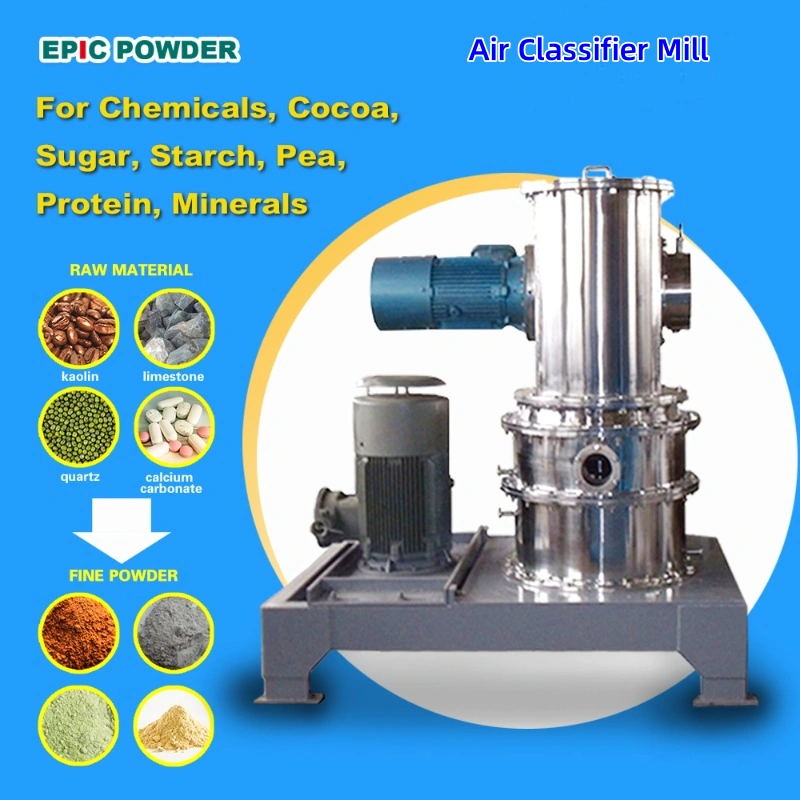
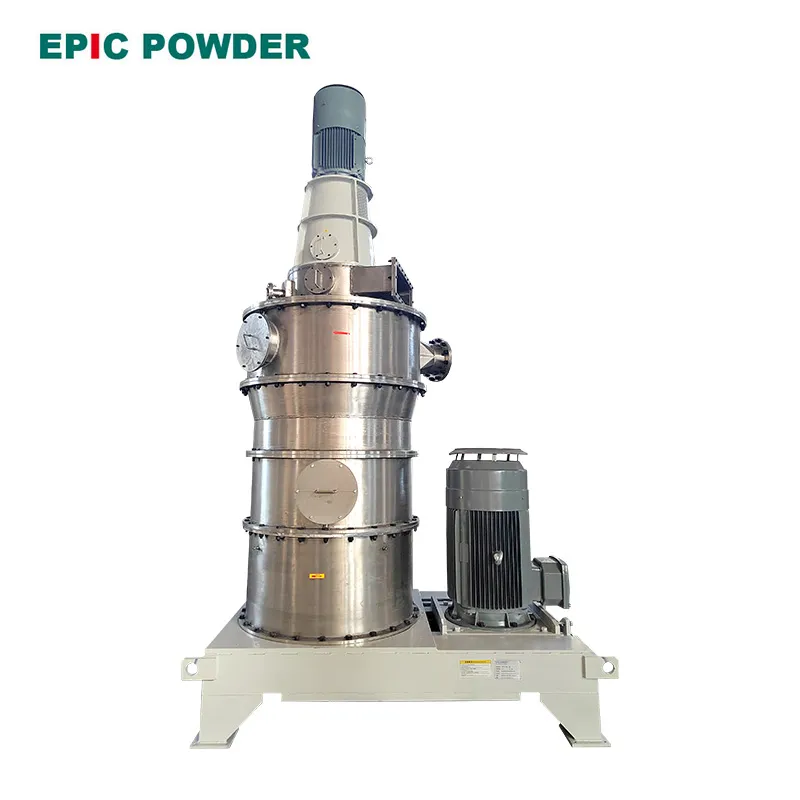
An air classifier mill integrates high-speed mechanical grinding with aerodynamic classification. Its core functions include:
- Particle Size Reduction: The ACM uses high-velocity impacts, shear, and collision forces to reduce coal tar pitch into ultrafine particles. This increases the surface area and prepares the material for uniform chemical or physical activation.
- Particle Classification: The integrated classifier wheel separates coarse and fine particles in real-time. Coarse particles are recirculated for further grinding, while fine particles are collected as the final product. This ensures a narrow particle size distribution (PSD), which is crucial for consistent activation and pore development.
- Heat Management: The airflow in ACMs also helps dissipate heat generated during grinding, reducing the risk of partial carbonization or thermal degradation of pitch.
The proper use of a Porous Carbon Air Classifier Mill enables the production of coal tar pitch powders with controlled particle size, high surface area, and minimized agglomeration—all prerequisites for high-performance porous carbon.
Pre-Treatment of Coal Tar Pitch
Before grinding, coal tar pitch typically undergoes pre-treatment to improve processability and final product quality:
Thermal Softening
Coal tar pitch is semi-solid at room temperature. Heating it to 100–200°C increases its fluidity, allowing it to feed consistently into the air classifier mill without clogging.
Solvent Treatment
In some cases, pitch is dissolved in solvents such as tetrahydrofuran (THF) or toluene and then precipitated. This reduces particle agglomeration and enhances the uniformity of the milled powder.
Removal of Impurities
Filtering or centrifugation can remove insoluble residues, which otherwise may damage mill components or create non-uniform carbon structures.
Key Process Parameters in Air Classifier Milling
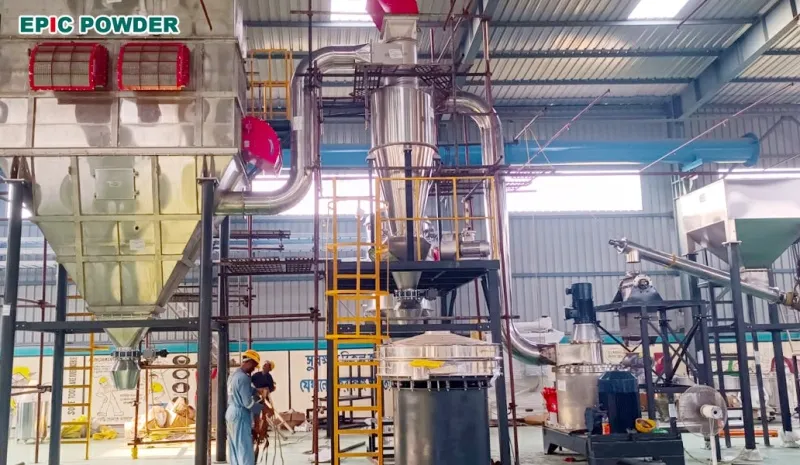
Optimizing the ACM process requires careful adjustment of multiple parameters:
Classifier Wheel Speed
The speed of the classifier wheel determines the cutoff size of particles:
- Higher speeds favor finer particle collection.
- Lower speeds allow coarser particles to pass through.
Precise control is essential for achieving the target particle size distribution, which influences subsequent activation.
Rotor Speed
The grinding rotor speed determines impact energy:
- Higher speeds produce finer particles and increase surface area.
- Excessive speed may generate heat and lead to partial carbonization or agglomeration.
Airflow Rate
Airflow serves both as a transport medium and as a cooling mechanism:
- High airflow enhances classification efficiency and removes heat.
- Low airflow increases residence time but may cause agglomeration.
Feed Rate and Temperature
- Consistent feed rates prevent sudden overload or underfeeding.
- Temperature control is critical to avoid softening or premature coking, which can block the mill.
Strategies for Optimizing Porous Carbon Surface Area
High-surface-area porous carbon is typically produced via activation, which can be chemical or physical. The milling process directly influences activation efficiency.
Particle Size Control
- Fine, uniform particles increase contact area with activating agents such as KOH, H₃PO₄, or steam.
- Narrow PSD reduces uneven pore formation and improves reproducibility.
Minimizing Agglomeration
- Agglomerated particles reduce effective surface area.
- Use of dispersants, controlled airflow, and classifier recirculation loops can help maintain particle separation.
Surface Defect Engineering
- Mechanical milling introduces microcracks and edge sites.
- These defects enhance chemical activation and the development of micropores.
Activation Methods
Chemical Activation
- Chemicals such as KOH, NaOH, ZnCl₂, and H₃PO₄ react with carbon, generating micropores.
- Fine particle size from ACM milling ensures uniform impregnation and activation.
- Typical procedure:
- Mix coal tar pitch powder with activating agent.
- Heat under inert atmosphere (N₂) to 600–900°C.
- Wash to remove residual chemicals.
Physical Activation
- Involves oxidizing gases like steam or CO₂ at 800–1000°C.
- Smaller particle size improves diffusion of gases and pore formation.
- ACM-processed powders generally exhibit higher BET surface areas compared to coarse powders.
Characterization of Porous Carbon
Proper evaluation ensures optimization and consistency:
Surface Area and Porosity
- BET Analysis: Determines specific surface area.
- BJH Method: Measures mesopore distribution.
- Target: 1500–3000 m²/g for high-performance carbons.
Morphology
- SEM/TEM: Visualizes pore structure and particle shape.
- ACM-milled powders typically show uniform morphology and minimal aggregation.
Chemical Composition
- XPS and FTIR: Confirm functional groups and carbon purity.
- Maintaining low oxygen content is critical for conductivity applications.
Troubleshooting Common Issues
Particle Agglomeration
- Cause: High temperature, excessive feed rate, insufficient airflow.
- Solution: Reduce rotor speed, increase airflow, or add anti-caking agents.
Equipment Wear
- Cause: Abrasive nature of coal tar pitch and impurities.
- Solution: Use wear-resistant materials (ceramic liners, tungsten carbide) in ACM.
Inconsistent Particle Size
- Cause: Improper classifier speed or irregular feed.
- Solution: Optimize classifier wheel speed, implement feedback control for feed rate.
Case Study: Optimized ACM Milling for High-Performance Porous Carbon
A practical example demonstrates the impact of ACM milling:
- Raw Material: Coal tar pitch with 88% fixed carbon.
- Pre-Treatment: Heated to 150°C, solvent-treated to remove heavy residues.
- Milling Parameters:
- Rotor speed: 3000 rpm
- Classifier speed: 1800 rpm
- Airflow: 2000 m³/h
- Feed rate: 50 kg/h
- Results:
- Particle size: D50 = 5 µm
- BET surface area after KOH activation: 2500 m²/g
- Pore distribution: 70% micropores, 30% mesopores
- Outcome: High adsorption capacity for CO₂ and superior capacitance when used as a supercapacitor electrode.
Conclusion
Optimizing high-surface-area porous carbon production from coal tar pitch requires a holistic approach combining material pre-treatment, precise ACM milling, and controlled activation processes. The Porous Carbon Air Classifier Mill plays a pivotal role in achieving uniform particle size, reducing agglomeration, and enhancing surface defects—each of which directly improves activation efficiency and final surface area. By carefully controlling milling parameters such as rotor speed, classifier wheel speed, airflow, and feed rate, manufacturers can produce high-performance porous carbon tailored for applications in energy storage, catalysis, and adsorption.
Future research may focus on integrating real-time process monitoring, advanced classifier designs, and hybrid activation techniques to further improve yield, reduce energy consumption, and expand the functional capabilities of coal tar pitch-derived porous carbon.

“Thanks for reading. I hope my article helps. Please leave a comment down below. You may also contact Zelda online customer representative for any further inquiries.”
— Posted by Emily Chen