In the field of agrochemical formulation, practitioners often face a puzzling dilemma: the purity of the Active Ingredient (AI) meets the standards, and the formula ratio is precisely calculated, yet the actual performance in field trials or application is underwhelming. Often, this manifests as reduced herbicide efficacy, severe phytotoxicity, or sedimentation and clumping. The core of the problem usually does not lie with the active ingredient itself, but rather with the “supporting actor” that makes up the vast majority of the formulation—the carrier. As the most commonly used inorganic carrier for herbicides, the performance of Bentonite directly determines the “life or death” of the pesticide. If the Bentonite fineness is improperly controlled or its dispersibility is poor, even the best active ingredient will fail to exert its intended herbicidal activity.
This article provides an in-depth analysis of how fineness and dispersibility impact efficacy from a microscopic perspective. It also explores how to optimize these properties through advanced milling processes.

I. The “Vital Chain” Between Carrier Physical Properties and Efficacy
Fineness: A Geometric Multiplier for Pesticide Coverage
The efficacy of a herbicide largely depends on its contact area with the target (weed leaves or soil surface).
- Surface Area Effect: As Bentonite fineness increases, its total specific surface area grows exponentially. Finer particles provide more loading sites for the active ingredient. This allows the pesticide to form a denser and more uniform film upon application.
- Soil Sealing Logic: For soil-treatment herbicides, extremely fine bentonite particles can penetrate the micro-pores of the soil surface. This creates a continuous “medicated soil layer.” If the fineness is coarse or the Particle Size Distribution (PSD) is too wide, large “blind spots” will remain in the soil, leading to weed leakage.
Dispersibility: A Smooth Path from Bottle to Weed
Dispersibility refers to the ability of carrier particles to remain independent and avoid agglomeration in water or other media.
- Anti-clumping Ability: Bentonite has natural water-swelling properties. If dispersibility is poor, it easily forms “fish-eye” clumps during the mixing process. These clumps encapsulate the active ingredients, causing spray nozzle clogging. More importantly, it leads to uneven concentration, resulting in localized crop damage and ineffective treatment areas.
- Suspension Rate Balance: In Suspension Concentrates (SC) or Wettable Powders (WP), good dispersibility ensures that bentonite particles generate sufficient electrostatic repulsion. This force offsets sedimentation caused by gravity, maintaining the stability of the formulation during its shelf life.
II. In-depth Analysis: How Bentonite Fineness Affects Formulation Performance

In production practice, we typically focus on two key indicators: D50 and D97.
Enhancement of Adsorption Capacity by Ultra-fine Powders
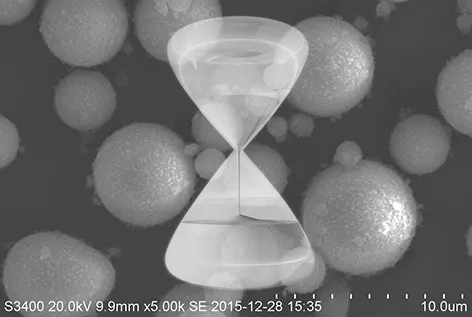
The layered structure of bentonite contains massive internal space. When the particle size is reduced to the micron or even sub-micron level through grinding equipment, the external specific surface area increases significantly. More importantly, the mechanical force “opens up” some of the closed crystal layer edges. This allows herbicide molecules to enter the interlayer domains faster and in larger quantities.
The “Law of the Minimum” in Particle Size Distribution (PSD)
It is not simply a case of “the finer, the better.” The uniformity of particle size distribution is equally critical.
- If the powder contains excessively large particles, sedimentation will accelerate, leading to uneven efficacy.
- If the powder is too fine and the distribution is too narrow, the viscosity of the formulation may become too high. This makes the product difficult to pour. Therefore, high-performance carriers pursue a state of “narrow and uniform” Bentonite fineness.
III. The Battle of Processes: Shaping Carrier Performance via Milling Equipment
Achieving ideal fineness and dispersibility requires professional powder processing equipment. Currently, the mainstream solutions in the industry include jet milling, ball milling, and bead milling. Each has a distinct effect on shaping bentonite.
제트 밀: The Pinnacle of Dry Processing

For the dry powder carriers required in Wettable Powders (WP) or Water Dispersible Granules (WDG), the jet mill is the preferred choice.
- 원칙: It utilizes high-speed compressed air to cause high-energy collisions between the materials themselves.
- 장점: * Low-Temperature Grinding: The expansion of the airflow has a cooling effect. This protects sensitive functional groups within the bentonite from heat-induced structural collapse.
- High Purity: No grinding media are involved, preventing ceramic or metal impurities from entering the carrier.
- Ultra-fine and Narrow Distribution: It easily achieves a Bentonite fineness of D97 < 10μm, significantly improving field adhesion.
Mechanical Impact Mill: The Cost-Effective Choice
For herbicide carriers with relatively lower requirements, mechanical impact mills (such as the MJW Series Air Classifier Mill) provide excellent efficiency. It strikes the material with a high-speed rotor. Combined with a built-in classification system, it allows for precise control over the final product fineness.
Bead Mill (Sand Mill): The Core of Liquid Formulations
In the production of Suspension Concentrates (SC), the bead mill is an indispensable wet-processing tool.
- Delamination Effect: The powerful shear force of a bead mill can “peel” stacked bentonite crystal layers into individual nano-sheets.
- Improving Dispersibility: Adding wetting and dispersing agents during the wet grinding process allows for surface coating simultaneously with size reduction. This fundamentally solves the problem of bentonite agglomeration in water.

IV. Bentonite Modification: Deep Optimization of Dispersibility
Physical grinding alone sometimes fails to meet the needs of high-end herbicides. By implementing synchronous modification during the milling process, dispersibility can be further enhanced.
- Organic Modification: Utilizing surfactants like quaternary ammonium salts to modify bentonite changes it from hydrophilic to lipophilic. This enhances its carrying capacity for hydrophobic pesticide molecules.
- Ion Exchange: Sodium treatment (sodiumization) increases the swelling ratio and potential value of the bentonite. This strengthens the electrostatic repulsion in aqueous solutions, ensuring long-term suspension without stratification.
V. Case Study: The Leap in Efficacy After Fineness Improvement
A herbicide manufacturer dealing with a crowfoot grass control project in Brazil initially used 325-mesh ordinary bentonite as a carrier. They found severe pesticide sedimentation and a weed mortality rate of only 65%.
The Improvement Plan:
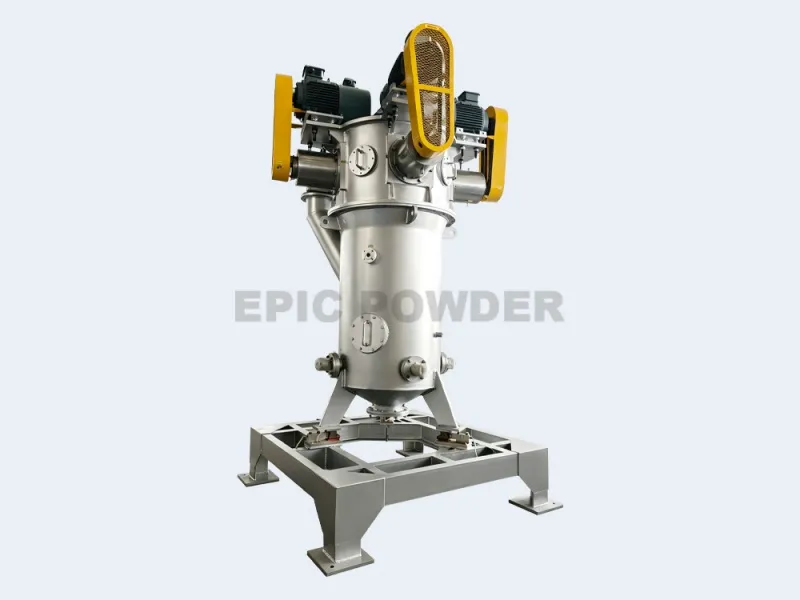
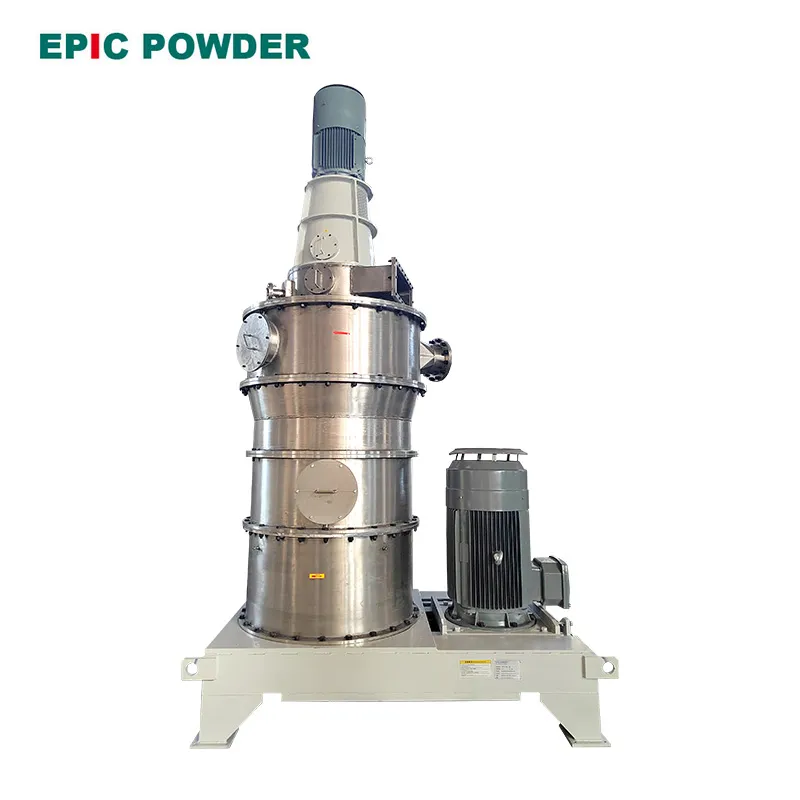
- Equipment Upgrade: Implementation of the Epic Powder MQW Series Jet Mill.
- Parameter Optimization: The Bentonite fineness was increased from 325 mesh (45μm) to D97 = 10μm.
- Results: Because the particles were significantly smaller, the adhesion of the pesticide to the weed surfaces strengthened. The resistance to rain wash also improved. At the same dosage of active ingredient, the weed mortality rate rose to 92%. Additionally, the suspension rate increased from 70% to over 95%.
결론 and Recommendations
The R&D of agrochemical formulations is a systematic project. Bentonite is the cornerstone of its physical architecture, and its importance cannot be overstated. If your herbicide products face efficacy fluctuations or instability, you must examine:
- Does the fineness meet the standard? Is there a need for deep processing using jet mills or ultra-fine mechanical mills?
- Is the Particle Size Distribution reasonable? Are there large particles affecting uniformity?
- Is the processing equipment matched? Is the choice between dry processing and wet grinding optimized?
In future market competition, the microscopic quality of a formulation will become its core competitiveness. Improving the physical properties of bentonite through sophisticated milling processes is the only path for every agrochemical engineer to achieve product upgrades.
Technical Selection Advice:
- For extremely narrow distribution and high purity , the 제트 밀 is recommended.
- For large-scale production and balanced cost control, the MJW Series Air Classifier Mill is the ideal choice.
- For liquid suspension formulations, high-energy Bead Milling is required to achieve nano-scale delamination and dispersion.

읽어주셔서 감사합니다. 제 글이 도움이 되셨으면 좋겠습니다. 아래에 댓글을 남겨주세요. 추가 문의 사항은 젤다 온라인 고객 담당자에게 연락하실 수도 있습니다.
— 게시자 에밀리 첸