리튬 이온 배터리 소재의 작동 원리: 미세 구조 및 초미세 분쇄 기술의 통합

The lithium-ion battery material system is highly complex. From electrochemical core materials to structural components, it can be divided into five major categories. In industrial production practice, 초미분 분쇄 (deagglomeration, dispersion, micronization, and nano-sizing) is a key engineering technology that determines whether these materials can be successfully applied.

I. Lithium-Ion Battery Cathode Material

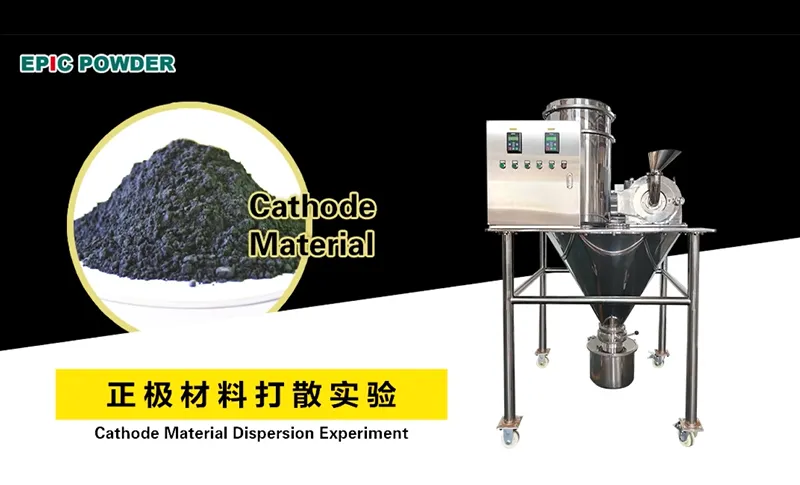
Cathode Materials Disperse

Cathode materials are the source of lithium ions in the battery, and their performance directly determines energy density, cost, and safety. After high-temperature solid-state calcination, cathode materials typically exist as hard agglomerates or dense blocks, which must be processed using ultrafine grinding equipment.

1.1 Layered Oxides (High energy density, relatively lower stability)

Layered oxide materials face a key challenge during ultrafine grinding: avoiding structural damage and excessive surface residual lithium formation.

Lithium Cobalt Oxide (LCO, LiCoO₂)

A dominant material in consumer electronics with high voltage platform and high tap density. Industrial production typically uses fluidized-bed jet mills or precision mechanical impact mills for ultrafine grinding. The goal is to achieve narrow particle size distribution while maximizing tap density.

Nickel Cobalt Manganese Oxide (NCM) / Nickel Cobalt Aluminum Oxide (NCA)

Mainstream materials for power batteries.

Polycrystalline ternary materials:
These consist of micron-scale secondary spheres formed by nano-primary particles. During grinding, jet milling under high-purity dry nitrogen protection is required. The mechanism relies on inter-particle self-collision to achieve “deagglomeration” without breaking secondary spheres, preventing exposure of fresh surfaces that would increase surface residual lithium (Li₂CO₃ / LiOH).

Single-crystal ternary materials:
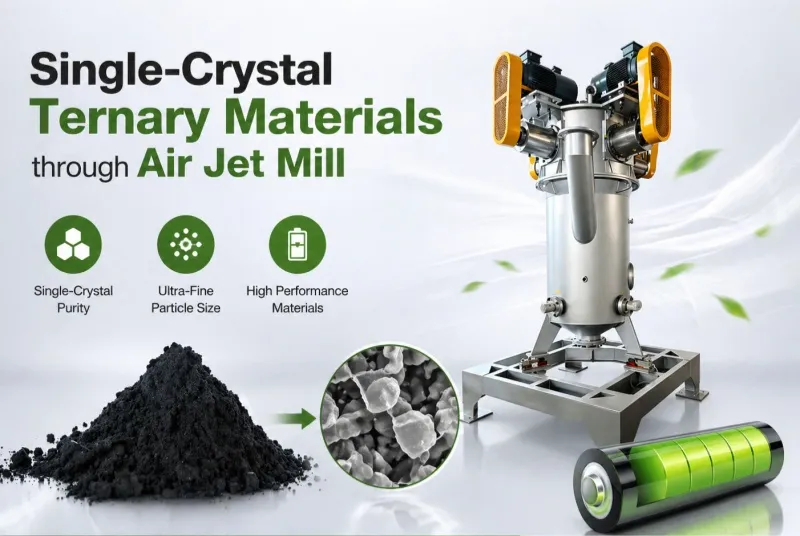
After calcination, they form extremely hard agglomerates. These must be processed using high-energy mechanical impact mills or wet stirred media mills (sand mills) to obtain independent single-crystal particles of 2–5 μm.

Lithium-Rich Manganese-Based Materials

Next-generation high-energy-density candidates. Due to poor rate performance, wet ultrafine sand mills are often used to reduce particle size to submicron levels (nano-sizing), shortening lithium-ion diffusion paths.

1.2 Olivine Structure (High stability, safety, long life)

Lithium Iron Phosphate (LFP) & Lithium Manganese Iron Phosphate (LMFP)

Ternary cathode Material Air Jet Mill

LFP suffers from extremely low electronic conductivity and lithium-ion diffusion coefficient. To activate its performance, an industrial strategy of “nano-sizing + carbon coating” is required.

Ultrafine grinding involvement:
In precursor batching stages, high-efficiency wet sand mills (zirconia beads of 0.1–0.3 mm) are used to ultrafinely grind iron source, phosphorus source, lithium source, and carbon source into nanoscale slurry (D50 < 100 nm). This ensures atomic-level contact during calcination.

After calcination, the final product is further deagglomerated by 제트 밀링 to meet electrode coating requirements.

1.3 Spinel Structure (Low cost, good safety)

리튬 망간 산화물(LMO)

LMO has moderate high-temperature stability and energy density. Ultrafine grinding typically uses jet mills or air-classification impact mills, controlling D50 around 10 μm. The key is to strictly avoid excessive fines, as too many ultrafine particles accelerate manganese dissolution into the electrolyte at high temperatures.

II. Lithium-Ion Battery Anode Material

The anode serves as the lithium-ion storage host and directly affects fast-charging capability, cycle life, and safety against lithium dendrite formation. Ultrafine grinding plays a critical role in particle shaping and nano-engineering.

2.1 Carbon-Based Materials (Dominant mainstream)

Graphite (Natural / Artificial)

Ultrafine grinding and mechanical spheroidization:
Natural graphite has a flake-like structure, which leads to anisotropic electrode behavior. Industrial processing requires vertical impact mills (pin mills/turbo mills) for ultrafine grinding, followed by spheroidizing equipment to convert flakes into spherical particles.

Classification deagglomeration:
Artificial graphite after ~3000°C graphitization tends to agglomerate. Jet milling and classification systems are used for gentle deagglomeration and precise particle size control.

Disordered Carbon (Hard/Soft Carbon)

Promising anode for sodium-ion batteries and fast charging. Precursors such as biomass or pitch require long-duration high-energy 볼 밀링 or impact milling to achieve ultrafine powders with tailored pore structures.

Carbon Nanotubes (CNT) / Graphene

Used as conductive additives. They are highly prone to agglomeration and require high-shear wet dispersion systems or ultrasonic microfluidic milling to fully disperse into uniform conductive networks.

2.2 Silicon-Based Materials (Next-generation anode, ultra-high capacity)

Silicon-Carbon (Si-C) / Silicon-Oxide (Si-O)

Silicon undergoes >300% volume expansion during cycling.

Ultrafine grinding involvement:
To mitigate stress, silicon must be reduced to nanoscale (<100 nm, sometimes <50 nm). Industrial processes typically useall-ceramic-lined ultra-fine wet sand mills , grinding micron-sized silicon into nano-silicon slurry under water or organic solvent systems. The resulting nano-silicon is then composited with carbon matrices.

2.3 Lithium Titanate (LTO)

A “zero-strain” material with excellent safety and cycle life but poor conductivity. Production uses a combination of wet grinding + spray drying + jet deagglomeration to achieve submicron particles.

2.4 Metallic Lithium

Prepared via molten processing or physical vapor deposition, and does not involve traditional ultrafine powder grinding.

III. Electrolyte

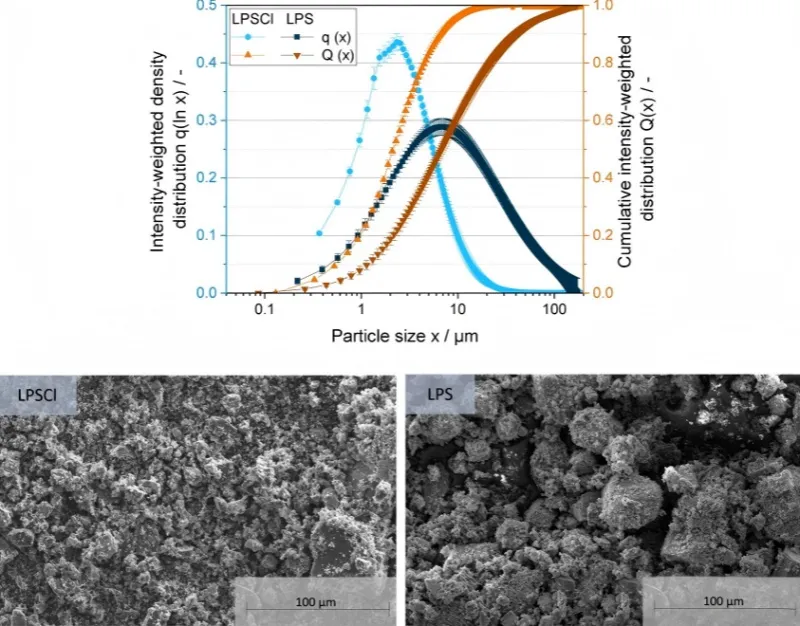
solid electrolytes
solid electrolytes

The electrolyte acts as the “highway” for lithium-ion transport and determines ionic conductivity and operating temperature range.

3.1 Liquid Electrolyte

Composed of lithium salts (e.g., LiPF₆, LiFSI), organic solvents, and additives. Although liquid systems do not require grinding, solid lithium salt precursors still require anti-moisture, explosion-proof ultrafine deagglomeration equipment during production.

3.2 Solid-State Electrolyte (Core of all-solid-state batteries)

Includes polymer, oxide (e.g., LLZO), and sulfide (e.g., LPS) systems.

Ultrafine grinding involvement:
The key challenge is high solid-solid interfacial resistance. Therefore, solid electrolytes must be nano-sized to maximize interfacial contact.

Sulfide electrolytes:

Highly sensitive to moisture and can generate toxic H₂S gas. They must be processed in glove boxes (argon atmosphere) using sealed high-energy planetary ball mills or wet sand mills with non-polar solvents, reducing particle size to several hundred nanometers to significantly improve room-temperature ionic conductivity.

IV. Separator

The separator is a porous insulating film that prevents direct contact between electrodes while allowing lithium-ion transport.

4.1 Base Film and Ceramic Coating

Mainstream materials are polyolefin microporous membranes (PE/PP). To improve thermal stability, ceramic coatings are applied.

Ultrafine grinding involvement:
Al₂O₃ or boehmite powders used for coating must have extremely fine and narrow particle size distribution to avoid membrane damage. Industrial production uses high-purity ceramic-lined sand mills, producing slurry with D50 ≈ 0.3–0.5 μm.

application of Ultrafine pulverizer in lithium-ion battery material
리튬이온전지 소재에 초미분쇄기 적용

V. Auxiliary and Structural Components

Although not directly involved in electrochemical reactions, they are crucial for electrode processing and battery performance.

5.1 Conductive Agents (Carbon black, graphite, CNT)

Finer and better-dispersed conductive particles form superior electronic networks.

During slurry preparation, high-shear dispersion machines, dual planetary mixers, or twin-screw continuous slurry dispersion systems are used to break agglomerates and uniformly distribute conductive additives.

5.2 Binders (PVDF, SBR, CMC)

Do not involve grinding, but some solid raw materials require mechanical pre-crushing to accelerate dissolution.

5.3 Current Collectors & Structural Components

Metal processing domain; no ultrafine grinding involved.

Conclusion: Ultrafine Grinding as the “Invisible Core Technology” of Lithium Batteries

From the entire system, one key conclusion can be drawn:

👉 Lithium-ion batteries are not purely “materials science”, but a deeply integrated system of powder engineering + ultrafine grinding technology + interface engineering.

Ultrafine grinding determines three core performance dimensions:

  • Energy density (particle size and packing)
  • Rate capability (diffusion pathway)
  • Safety (structural uniformity)

In modern lithium battery industry:

👉 Material synthesis defines the lower limit, while ultrafine grinding defines the upper limit.

Whoever masters nanoscale powder structure control and classification systems will dominate the next generation of power battery technology.


Emily Chen

읽어주셔서 감사합니다. 제 글이 도움이 되셨으면 좋겠습니다. 아래에 댓글을 남겨주세요. 추가 문의 사항은 젤다 온라인 고객 담당자에게 연락하실 수도 있습니다.

— 게시자 Emily Chen

    다음을 선택하여 인간임을 증명하세요..

    위로 스크롤