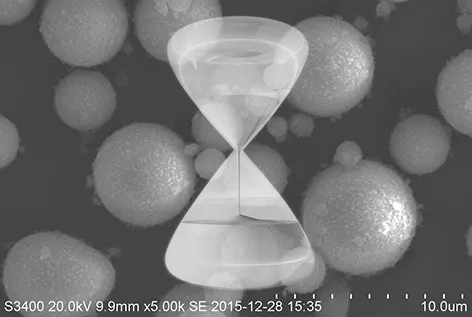
Limestone (primarily CaCO₃) has become one of the most widely used functional fillers in the non-metallic mineral industry. From heavy calcium carbonate at 800 mesh (~20 μm) to active light calcium at 2500 mesh (D97≈5–8 μm), and even nano-active calcium at 3000–6500 mesh (D97≈2–4 μm), limestone powder is critical in plastics, coatings, paper, rubber, PVC flooring, desulfurization slurry, and PCC precursor production. However, achieving ultra-fine fineness while controlling energy consumption remains a central challenge for modern milling plants.
초미세 분쇄 of limestone is inherently energy-intensive. As particle size decreases, the specific surface area increases, and the energy required to break particles rises exponentially. For example, reducing the D97 from 10 μm to 5 μm often doubles or triples energy consumption. Traditional ball mills and Raymond mills become uneconomical below 1250 mesh. Newer energy-saving solutions, such as ultrafine vertical roller mills (VRM), superfine mills, and optimized table roller mills, now provide industrial options for balancing fineness and energy consumption.
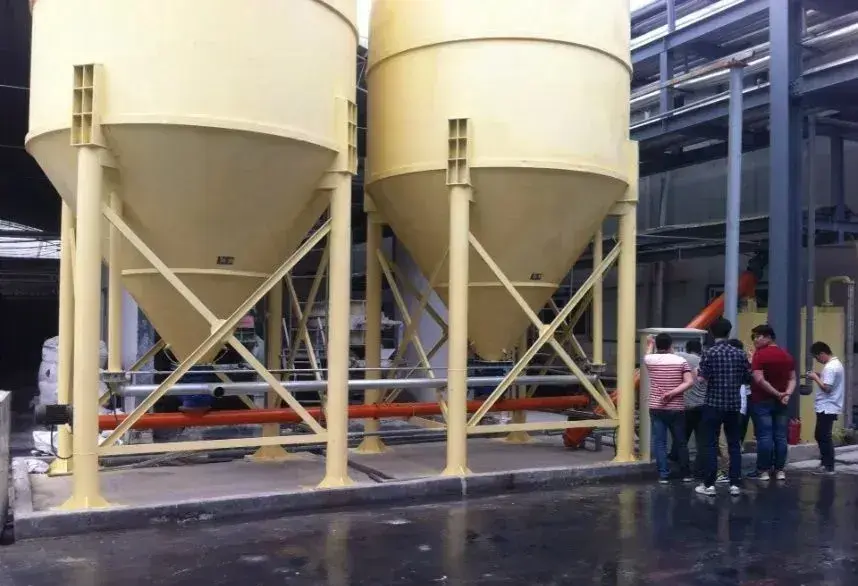
Question 1: Why does energy consumption increase so sharply at ultra-fine particle sizes?
The energy-fineness relationship of limestone grinding is highly non-linear. While coarser grinding (325–800 mesh) requires 12–55 kWh/t, reducing particle size to 1250–2500 mesh can push energy consumption to 50–220 kWh/t. At sub-5 μm, superfine mills such as stirred media mills and jet mills can consume 300–600+ kWh/t.
Several factors contribute to this phenomenon:
- Specific Surface Area Growth – The finer the particle, the more surface area is generated, requiring significantly more energy.
- Particle Agglomeration – Fine limestone tends to clump, cushioning impacts and reducing grinding efficiency.
- Reduced Impact Efficiency – Traditional laws like Rittinger’s predict energy for surface creation, but at sub-10 μm, efficiency drops due to particle-particle interactions.
- Over-grinding – Already fine particles continue to circulate and get re-ground, wasting energy.
The key to energy optimization lies in delaying or flattening the exponential energy increase through precise classification, correct stress application, and optimized flow design.
Question 2: How can a plant select the most energy-efficient mill for a given fineness target?
Mill selection depends primarily on the target D97 and production scale:
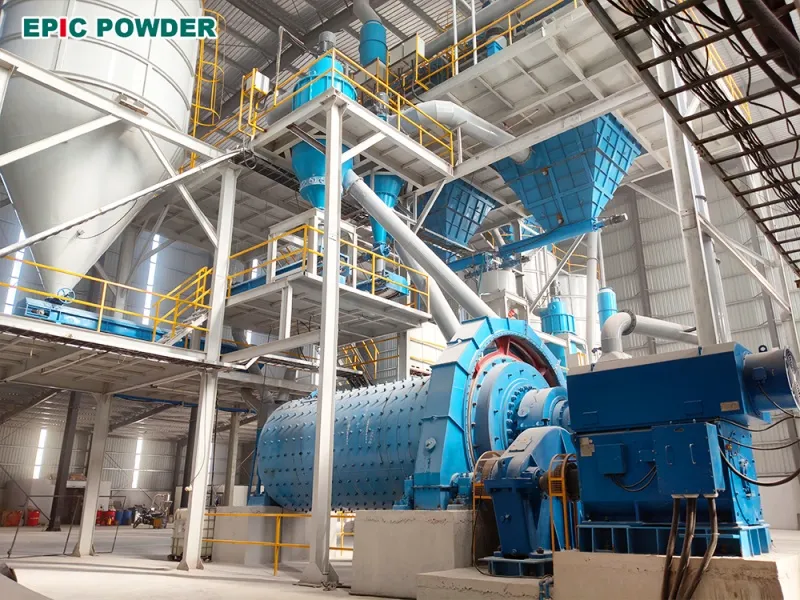
- D97 10–20 μm: Superfine VRM or table roller mills with multi-head classifiers are optimal. They use material bed compression, reducing energy by 30–50% compared to conventional ball mills.
- D97 5–10 μm: High-efficiency ball mills with turbo classifiers or ultrafine VRMs achieve sharp particle cuts and minimize over-grinding. Superfine Mill systems are recommended in this range for improved efficiency.
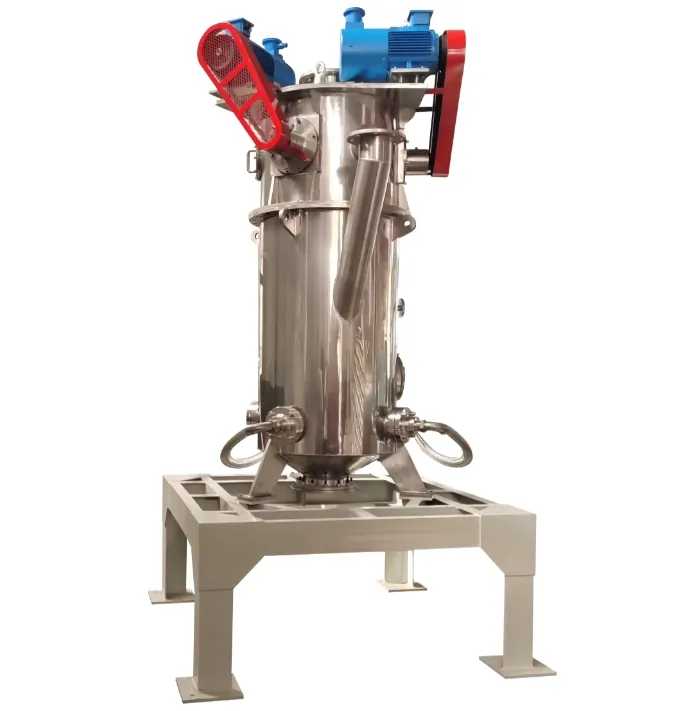
- D97 2–5 μm: Vertical stirred media mills or horizontal agitated mills provide high shear and media-intensive contact, enabling finer products with controlled energy use.
- D97 <3 μm: 제트 밀 or nano bead mills are generally reserved for laboratory-scale or specialty applications due to extreme energy costs and media wear.
Accurate classification is critical. Multi-rotor dynamic classifiers, or high-efficiency classifier heads, reduce over-grinding, returning coarse particles immediately to the mill. Sharp classification not only improves fineness consistency but also lowers specific energy consumption by 20–35% in many industrial cases.
Strategy 1: Optimizing Grinding Force Application
The way grinding force is applied significantly impacts energy efficiency:
- Material Bed Compression (VRM): Ideal for 5–20 μm, where the feed forms a bed under rollers, generating uniform shear and compression.
- Shear-Dominated Media Contact (Stirred Mill): Extends economical grinding to 1–5 μm while maintaining energy efficiency.
- Avoid Pure Impact: Jet mills are efficient only for very fine products (D97 <3 μm) but are energy-intensive on larger scales.
By selecting the correct mill type, operators can achieve the desired fineness with minimal energy use.
Strategy 2: Classification Efficiency and Circulation Control
The classifier is often the most impactful component in energy saving:
- Achieve a narrow cut: d75/d25 <1.3–1.5 ensures uniform particle size.
- Return coarse particles promptly to reduce internal circulation load.
- Adjustable online classifiers allow real-time optimization for feed variations.
Practical Example 1: A limestone plant producing 2500 mesh (D97≈6–8 μm) used a HLMX VRM with multi-head classifier. Energy consumption was 135–165 kWh/t, 35–40% lower than a traditional ball mill loop at similar fineness.
Practical Example 2: A ground calcium carbonate plant targeting D97=10 μm upgraded to Alpine AWM-F with ACP classifier. Achieved 105 kWh/t for 6 t/h production, a >30% saving compared to conventional ball mill loops.
Strategy 3: Operating Parameter Optimization
Key parameters include:
- Roller Pressure / Tip Speed: Higher pressure or speed produces finer particles but increases energy. Operators should find the optimal “sweet spot.”
- Media Size & Filling Ratio: For stirred mills, a 20:1 media-to-feed ratio is often ideal. Smaller media enable finer products but raise energy and wear.
- Solids Concentration: Wet stirred mills often perform best at 50–65% solids. Too low → high energy; too high → viscosity rise.
- Feed Rate vs. Motor Load: Maintain 80–95% load without overloading.
- Grinding Aids: Certain dry-process aids can reduce energy consumption by 10–25% at D97≈8 μm.
Practical Example 3: In a stirred media mill producing D97≈3–5 μm, optimizing tip speed and maintaining 55–60% solids reduced energy consumption by 20–25% compared to default settings.
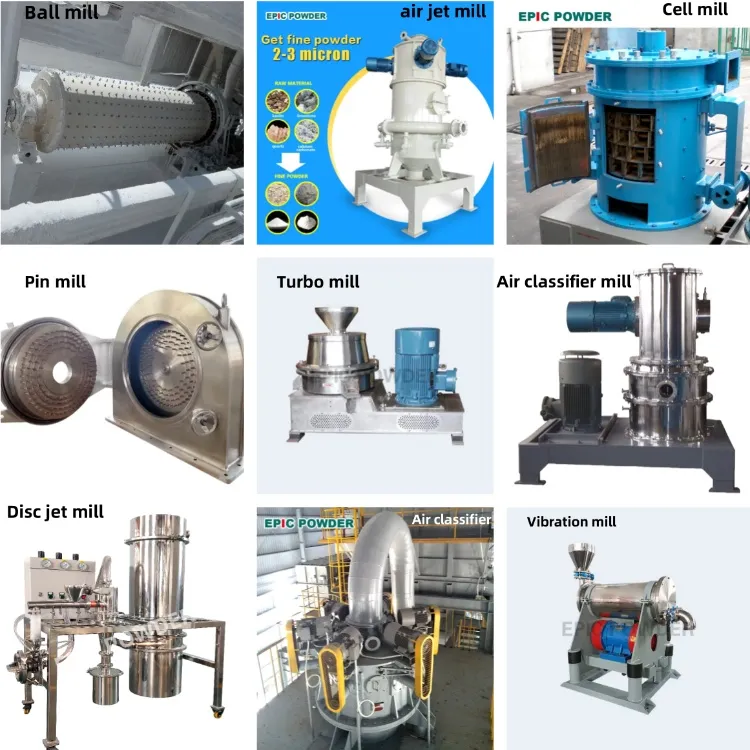
System-Level Optimization
- Closed-Circuit Operation: Combines mill and classifier in one loop, reducing energy by 25–40% relative to open-circuit operation.
- Hot-Air Drying Integration: Eliminates the need for separate dryers for 3–8% moisture limestone.
- Variable Frequency Drives (VFDs): Match motor speed and load to instantaneous requirements.
- AI-Based Control: Emerging AI systems can predictively adjust parameters in real-time, offering 5–15% additional energy savings.
결론
Optimizing limestone superfine mills requires a systematic approach that balances fineness targets with energy use:
- Understand the energy-fineness relationship and its exponential rise below 10 μm.
- Choose the correct mill type based on target D97 and production scale.
- Implement sharp, adjustable classification to reduce over-grinding.
- Optimize operating parameters and monitor motor load and media characteristics.
- Use closed-loop systems and emerging AI optimization tools for further savings.
By following these strategies, modern limestone plants routinely achieve 30–50% energy savings compared to traditional grinding circuits while meeting stringent particle size requirements, ensuring both product quality and cost efficiency. The adoption of superfine mills solutions is a critical step toward industrial competitiveness.

읽어주셔서 감사합니다. 제 글이 도움이 되셨으면 좋겠습니다. 아래에 댓글을 남겨주세요. 추가 문의 사항은 젤다 온라인 고객 담당자에게 연락하실 수도 있습니다.
— 게시자 에밀리 첸