
With the rise of the circular economy, a biomass materials company in Turkey sought to transform waste coffee grounds into high-value industrial raw materials. Post-drying, coffee grounds are characterized by their natural oil content and thermal sensitivity, presenting unique challenges for coffee grounds ultrafine grinding . This requires strict temperature control during the process to prevent oil extraction or material charring.
Project Core Parameters
- Material: Spent Coffee Grounds (Dried, 1% moisture)
- Equipment: Epic Powder Air Classifier Mill (ACM)
- Feed Size: 800–1000 µm
- Product Size: 20–40 µm (approx. 400–800 mesh)
- Capacity: 50 kg/h
- Applications: Bio-based plastic fillers, cosmetic additives, and organic pigments.
Core Challenges & Solutions
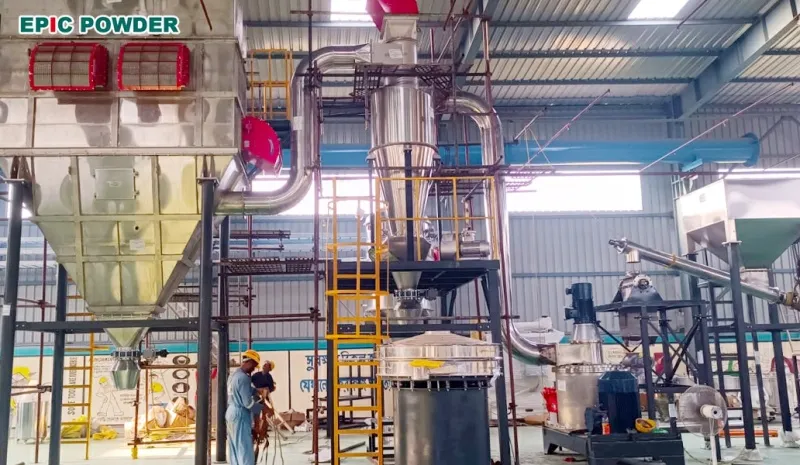
1. Managing Thermal Sensitivity and Oil Content
Coffee grounds contain natural oils that can release aromatic compounds or become “sticky” when heated, leading to screen blinding in traditional mills.
- The Solution: The ACM (Air Classifier Mill) system was selected. This equipment utilizes high-volume airflow for grinding; the air stream acts as a cooling agent while transporting the material. The integrated classifier wheel controls particle size precisely without the need for a screen, fundamentally solving the “screen clogging” issue common in traditional pulverizers.
2. Precise Control of Particle Size Distribution (PSD)
To ensure uniformity for downstream plastic or cosmetic applications, the client required a tight particle size range of 20–40 µm.
- The Solution: The Epic Powder ACM features an integrated impact grinding and turbine classification design. By adjusting the frequency of the classifying rotor, the system intercepted particles that had not reached the target fineness. This ensured that d90 and d97values remained strictly within range, resulting in a powder with excellent flowability.
3. Stability for Small-Batch, High-Precision Production
A capacity of 50 kg/h is typical for pilot-scale or specialized production, requiring the equipment to maintain stable performance even at lower feed rates.
- The Solution: The Epic Powder ACM features an integrated impact grinding and turbine classification design. By adjusting the frequency of the classifying rotor, the system intercepted particles that had not reached the target fineness. This level of control is essential for successful coffee grounds ultrafine grinding, ensuring that d90 and d97 values remain strictly within range.
Process Overview
- Automated Feeding: Dried coffee grounds (1% moisture) are delivered into the grinding chamber via a screw feeder.
- Impact Grinding: High-speed rotating hammers apply strong impact and shear forces to the material.
- Internal Classification: Ground particles rise with the airflow. Qualified 20–40 µm particles pass through the classifier wheel, while oversized particles fall back for further grinding.
- Cyclone Collection: A high-efficiency cyclone collector gathers the finished product. The exhaust air is filtered by a pulse-jet bag house, ensuring a dust-free and odor-controlled working environment.
Performance Results
| Metric | Target Requirement | Actual Result |
| Product Fineness (d97) | 20–40 µm | 22.5 – 38.6 µm |
| Capacity | 50 kg/h | 55 kg/h (Stable) |
| Material Quality | No discoloration/oil leakage | Maintained color, dry and uniform |
| System Cleaning | Easy disassembly | Modular design for quick material changeover |