In the field of modified powder, dispersibility is universally recognized as the “lifeline” that determines product value. The reason it has become the industry’s foremost challenge is not due to a theoretical or technical knowledge gap, but rather a systemic difficulty arising from the inherent characteristics of powders, the constraints of industrial-scale production, and the stringent demands of downstream applications. These three factors are deeply intertwined and directly impact production efficiency, product quality, and market competitiveness.
Below is an analysis based on real industrial practice, structured across key dimensions.
The “Innate Nature” of Powder Agglomeration: The Root Cause of the Dispersibility Problem
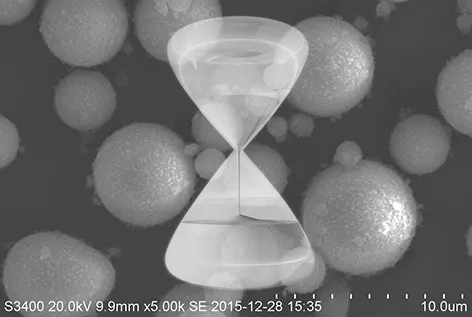
The core raw materials for modified powder (such as nano-calcium carbonate, fumed silica, anatase titanium dioxide, etc.) is mostly ultrafine particles (10 nm–5 μm). Their inherent physical and chemical properties make agglomeration a thermodynamically spontaneous process, creating a fundamental barrier to improving dispersibility.
In actual production, the extremely high specific surface area of ultrafine powders leads to a sharp increase in surface energy. For example, calcium carbonate with a particle size of 100 nm can have a specific surface area of 50–80 m²/g — 10–20 times higher than micron-sized powders. Unsaturated surface atoms generate strong adsorption potential, driving particles to spontaneously aggregate into “secondary agglomerates” to minimize total system energy.
Even more challenging is hard agglomeration. During drying or calcination, particles form “sintered necks” via hydroxyl bridging or lattice fusion. The bonding energy of such agglomerates can reach 10–20 kJ/mol. This far exceeds the shear force provided by conventional mechanical stirring.
Related Cases
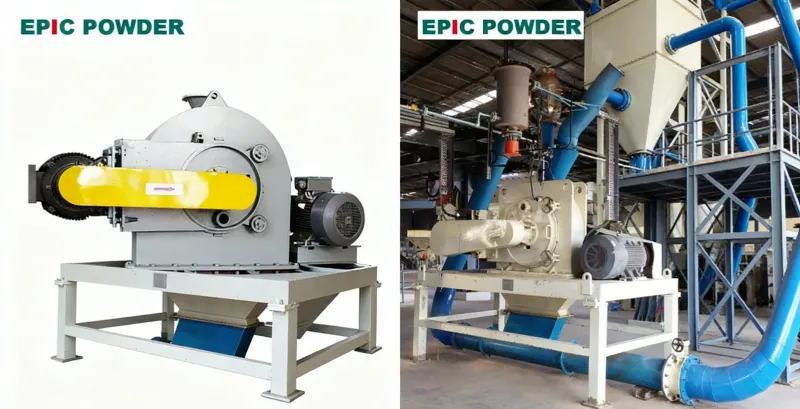
In one nano-silica modification project, improper spray drying resulted in hard agglomerates larger than 50 μm. Even a high-speed mixer at 1200 r/min could only break them down to 5–10 μm clusters. Effective de-agglomeration required an air jet mill (operating at 0.8 MPa). However, this led to 40% higher energy consumption and damaged the particle morphology.
Moreover, surface polar groups further exacerbate agglomeration. For example, silanol groups (–SiOH) on nano-silica surfaces form strong hydrogen bonds, while carboxyl and hydroxyl groups on titanium dioxide surfaces generate electrostatic attraction. These effects become significantly stronger in humid environments.
One coastal modified powder manufacturer experienced batch-scale agglomeration and quality deterioration. Investigation revealed that warehouse humidity exceeded 65%, strengthening inter-particle hydrogen bonding. Products that originally met dispersibility standards developed severe caking after only 15 days of storage, resulting in the scrapping of 20 tons of material.
The “Chain Reaction” of Dispersion Failure: Directly Negating the Value of Modification
The core functions of modified powders—such as reinforcement, toughening, light shielding, and conductivity—depend on the uniform dispersion of particles within the matrix. Once dispersion fails, systemic quality problems occur, and prior modification efforts lose their value. This is why dispersion control is the industry’s primary challenge.
In plastic modification, a company supplied stearic acid–modified calcium carbonate with a grafting rate of 2.8%, well above the 1.5% industry standard. Hydrophobicity also met requirements. However, the customer found that pipe impact strength reached only 60% of the standard, with visible white spots in the cross-section. TEM analysis showed that calcium carbonate existed as 5–10 μm agglomerates in the polyethylene matrix. The modifier coated only the surface of these agglomerates, leaving inner particles untreated. This caused poor interfacial bonding and stress concentration, leading to brittle fracture. The incident resulted in a three-day production shutdown and losses exceeding RMB 800,000. The root cause was the lack of proper pre-dispersion treatment before modification.
The coating industry has even stricter dispersion requirements. An automotive paint manufacturer using modified titanium dioxide experienced orange peel defects, gloss reduction (from 95° to 72°), and insufficient scratch resistance. Although laser analysis showed D50 = 1.2 μm, the primary particle size should have been 0.2 μm. Investigation revealed insufficient shear force due to worn mixer blades, meaning agglomerates were not fully broken apart. The modifier coated only the agglomerate surface.
These cases confirm an industry consensus: dispersion is “1,” while other modification properties are “0.” Even with proper modifier selection and qualified grafting rates, poor dispersion renders the product ineffective.
The “Technical Gap” Amplified by Industrialization: The Severe Challenge from Lab to Production Line
Dispersibility can be controlled in the lab through precise measures. However, industrial-scale production introduces scale effects and equipment limitations. This creates a major “lab-feasible but plant-impossible” technical divide.
First is the uneven shear force distribution caused by scale-up. A laboratory 5L high-speed mixer can achieve paddle tip speeds of 15 m/s with uniform shear, whereas a 5000L industrial mixer is typically limited to 8–10 m/s due to blade size constraints. Shear force can vary by up to 3 times between wall and center regions, causing over-agglomeration at the edges and under-modification in the center.
In a 10,000-ton modified calcium carbonate project, qualified dispersibility rate was raised from 65% to 92% only after adding flow deflectors, optimizing blade angle (from 45° to 60°), and implementing staged speed control (initial 1000 r/min for dispersion, mid-stage 800 r/min for modification, final 600 r/min for homogenization).
Second is the difficulty of maintaining stability in continuous production. Lab batch processes allow precise control of timing. Industrial lines suffer from feed rate fluctuations (±5%). This disrupts the dispersant concentration balance. In one graphene project, a feeder jam caused insufficient dispersant. This resulted in 12 tons of product with excessive sheet stacking, making it unusable for battery electrodes.
Additionally, secondary agglomeration risks during storage and transportation cannot be ignored. In one nano-silica project, workshop samples showed excellent dispersion (TEM ≥90% single particles), but after 1200 km road transport, customer testing revealed 35% agglomerates. The issue was eventually resolved by switching to vacuum aluminum-plastic composite bags with inert gas protection and limiting bag weight to ≤25 kg (to avoid compression), though packaging cost increased by 12%.
Systemic Absence” in Evaluation Standards: Intensifying the Difficulty of Dispersion Control
Unlike quantifiable indicators such as grafting rate and particle size distribution, there is no unified standard for evaluating dispersion. Moreover, dispersion performance is strongly tied to specific downstream application scenarios, making the judgment of “qualified or not” uncertain and further amplifying its complexity as a technical challenge.
Current testing methods each have their limitations. A laser particle size analyzer measures “apparent particle size” and cannot distinguish between individual particles and loosely agglomerated clusters. For example, a modified titanium dioxide sample showed D50 = 0.3 μm (meeting the standard) according to laser analysis, yet scanning electron microscopy (SEM) revealed a large number of soft agglomerates ranging from 0.5–1 μm. Transmission electron microscopy (TEM) can observe microscopic morphology, but its sampling amount is only at the microgram level, limiting representativeness. There have been cases where laboratory spot checks passed, but entire customer batches were rejected. Rheometers assess dispersion by measuring system viscosity, but results are easily affected by matrix viscosity, temperature, and other factors. The same powder can show up to a twofold difference in test results when evaluated in epoxy resin versus polyurethane systems.
More fundamentally, application-oriented dispersion standards vary greatly. For instance, modified calcium carbonate used in PVC pipes requires “no visible agglomerates in the resin matrix.” In contrast, modified alumina for electronic encapsulation adhesives must achieve “nano-scale single-particle dispersion with a sedimentation rate ≤ 0.5% within 24 hours.” One company once supplied the same grade of modified silicon micropowder to two customers: one used it in ceramic glazes (where slight agglomeration was acceptable), while the other used it in photoresist formulations (requiring zero agglomeration). As a result, three different sets of dispersion process parameters had to be developed. Even the dispersant selection shifted from fatty acid-based types to polycarboxylates, increasing R&D costs by nearly 50%.
Conclusion: Core Industrial Practice for Dispersibility Control
Based on industrial experience, dispersion has become the primary challenge in modified powder. The root cause lies in the inherent tendency of powders to agglomerate. This conflicts with the rigid requirements of industrial-scale production and downstream applications.
To solve this challenge, companies must move beyond optimizing a single process step. Instead, they need to build a full-chain technical system. This system should include raw material pretreatment, precise control of modification processes, reinforcement of dispersion stability, and adaptation to specific application scenarios.
In practice, three key strategies are essential.
- First, at the raw material stage, jet milling should be combined with classification technology. This helps pre-break hard agglomerates.
- Second, during the modification stage, dispersants and modifying agents must work synergistically. A “disperse first, then modify” sequence control strategy should be adopted. This improves coating uniformity.
- Third, companies should establish a customer application scenario database. This allows targeted optimization of dispersion process parameters.
Ultimately, competition in the modified powder industry comes down to dispersion control capability. Dispersion must be treated as a core technical indicator. It should run throughout the entire production process. Only in this way can the functional value and market competitiveness of modified powder truly be realized.

“Thanks for reading. I hope my article helps. Please leave a comment down below. You may also contact Zelda online customer representative for any further inquiries.”
— Posted by Emily Chen