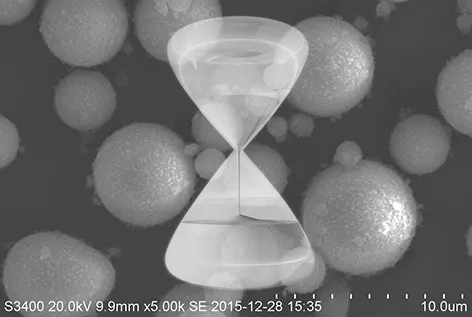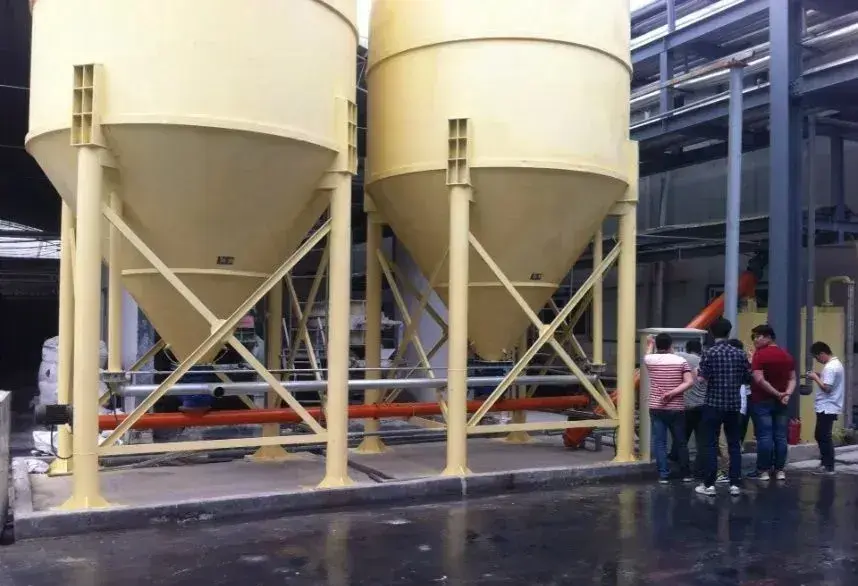
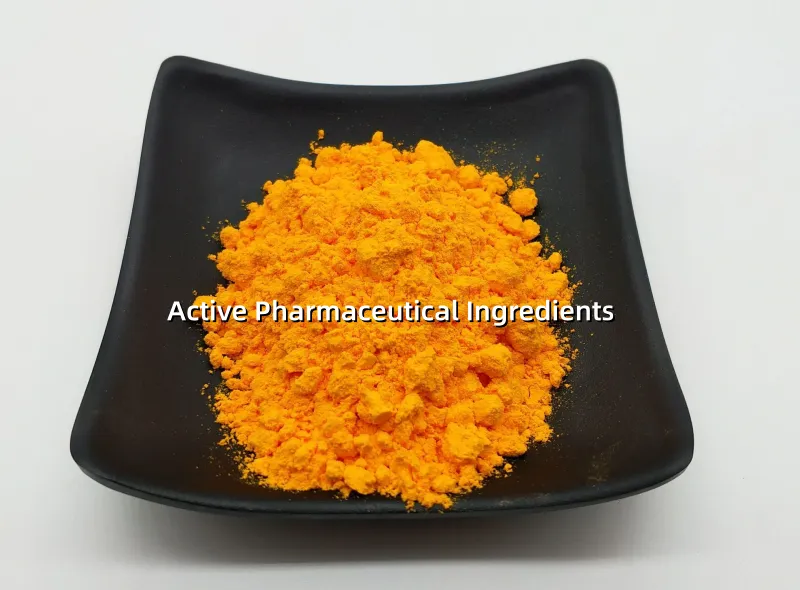
Micronization is a critical process in pharmaceutical manufacturing that reduces active pharmaceutical ingredients (APIs) to micron or submicron particle sizes, typically 1-10 μm. This enhances bioavailability, dissolution rates, and uniformity in formulations, especially for poorly soluble pharmaceuticals. For temperature-sensitive APIs—those prone to degradation, melting, or chemical changes at elevated temperatures—the grinding method must minimize heat generation while maintaining purity and preventing contamination. Common micronization techniques include mechanical milling (e.g., ball or hammer mills), wet milling, and jet milling. Among these, spiral jet mill grinding (also known as disc jet milling) is widely used due to its unique particle-on-particle grinding mechanism, which provides ultra-low heat build-up, narrow particle size distribution, and extremely high product purity—making it especially suitable for sensitive and high-value pharmaceutical materials.
What Is a Spiral Jet Mill?
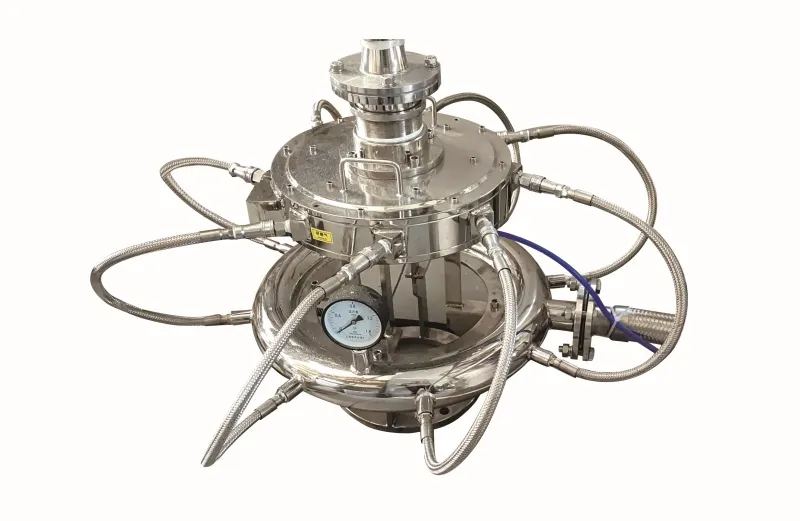
A spiral jet mill, also known as a disc jet mill, uses high-velocity compressed gas to create spiral airflow within a flat grinding chamber. Particles accelerate along the spiral path and collide with each other, resulting in ultra-clean impact-based grinding.
Key Characteristics
- No mechanical contact: No grinding media or moving parts inside the chamber.
- Minimal heat generation: Grinding occurs through particle-to-particle collision.
- Narrow particle size distribution: Ideal for D50 < 3 µm or even submicron APIs.
- Extremely low contamination: Critical for high-purity pharmaceutical materials.
- Closed-loop inert gas operation optional: Suitable for oxygen-sensitive APIs.
These features give spiral jet mills a clear advantage in temperature-sensitive applications.
Benefits for Temperature-Sensitive Pharmaceutical Ingredients
Ultra-Low Heat Build-up
Because no mechanical components create friction, temperature rise is minimal. This protects APIs with thermal degradation risks.
High Purity and No Metal Contamination
The absence of grinding media eliminates metal wear, aligning with GMP and purity requirements.
Excellent Control of Particle Size
Spiral jet mills can reliably achieve fine powders (1–5 µm) with narrow PSD—critical for inhalation products, injectables, and high-surface-area APIs.
Suitable for Fragile or Polymorphic Materials
Since the grinding action is gentle and driven purely by gas energy, polymorphic transitions are minimized.
Ideal for Hazardous or Oxygen-Sensitive APIs
With an inert nitrogen loop, explosion risk and oxidation reactions can be avoided.
Limitations to Consider
Despite their advantages, spiral jet mills are not universal solutions.
Not Suitable for Very Hard Materials
Extremely hard or abrasive APIs may not break efficiently through particle-to-particle collisions alone.
Relatively Low Throughput
Jet mills typically have lower capacity than mechanical mills, making them more suitable for high-value APIs rather than bulk intermediates.
Requires Consistent Feed Size
Feed materials often need pre-crushing to <100 µm to ensure efficient jet milling.
Higher Energy Consumption
Gas compression requirements increase operating costs.
When Is Spiral Jet Milling the Ideal Choice?
Spiral jet mills are most advantageous when:
- The API is highly temperature-sensitive
- Metal contamination must be strictly avoided
- Ultrafine particle size (D50 1–5 µm) is required
- Narrow distribution is critical (e.g., inhalation drugs)
- The API is fragile or polymorph-sensitive
- Process must follow GMP and high-purity standards
In these cases, spiral jet milling provides superior performance compared to pin mills, ball mills, or hammer mills.
Conclusion
Yes—spiral jet mill grinding is often the ideal solution for temperature-sensitive APIs, thanks to its particle-to-particle grinding mechanism, minimal heat build-up, and contamination-free operation. While it may not be suitable for all materials, its unmatched ability to produce ultrafine, consistent, high-purity powders makes it a leading choice in pharmaceutical manufacturing.
For pharmaceutical companies aiming to optimize API quality, enhance solubility, or achieve strict particle size targets, spiral jet milling offers a reliable and technologically advanced pathway.
Epic Powder, 20+ years of work experience in the ultrafine powder industry. Actively promote the future development of ultra-fine powder, focusing on crushing, grinding, classifying and modification process of ultra-fine powder. Contact us for a free consultation and customized solutions! Our expert team is dedicated to providing high-quality products and services to maximize the value of your powder processing. Epic Powder—Your Trusted Powder Processing Expert !

“Thanks for reading. I hope my article helps. Please leave a comment down below. You may also contact Zelda online customer representative for any further inquiries.”
— Posted by Emily Chen