In the era of rapid growth in new energy vehicles and energy storage batteries, lithium carbonate serves as a key raw material for lithium-ion battery cathodes. Its quality directly affects battery energy density, cycle life, and safety. The ultrafine grinding process of lithium carbonate is one of the core steps in production. By reducing coarse lithium carbonate particles to micron or even submicron levels, the process enhances reaction activity, improves dispersion, and optimizes slurry uniformity and electrochemical performance. However, selecting the appropriate grinding equipment is crucial. Currently, mainstream ultrafine grinding equipment falls into two main categories: jet mills and mechanical mills.
This article provides an in-depth comparison of their performance differences in lithium carbonate ultrafine grinding. It analyzes their respective advantages and disadvantages and ultimately explores which equipment is better suited for this specific application scenario.
Background and Significance of Lithium Carbonate Ultrafine Grinding
Lithium carbonate (Li₂CO₃) is a white powder compound. It is mainly extracted from salt lake brine or spodumene ore.
With the explosive growth of lithium battery demand, global lithium carbonate production has increased from approximately 200,000 tons in 2015 to more than 1 million tons in 2025.
Battery-grade lithium carbonate requires extremely strict particle size control. Typically, D50 (median particle size) must be controlled below 5–10 μm. Some high-end applications even require D90 < 20 μm.
This is because ultrafine lithium carbonate mixes more effectively with nickel-cobalt-manganese precursors. It helps form a dense cathode material structure, improves lithium-ion migration rates, and enhances charge-discharge efficiency.
Ultrafine grinding is not merely a size reduction process. It is a critical step in optimizing material performance.
If the particle size is too coarse, battery electrodes may become non-uniform, and capacity fading may accelerate. Conversely, if the powder is too fine, excessive surface energy may increase agglomeration and create safety risks.
Therefore, grinding equipment must balance fineness, distribution uniformity, purity, and energy consumption.
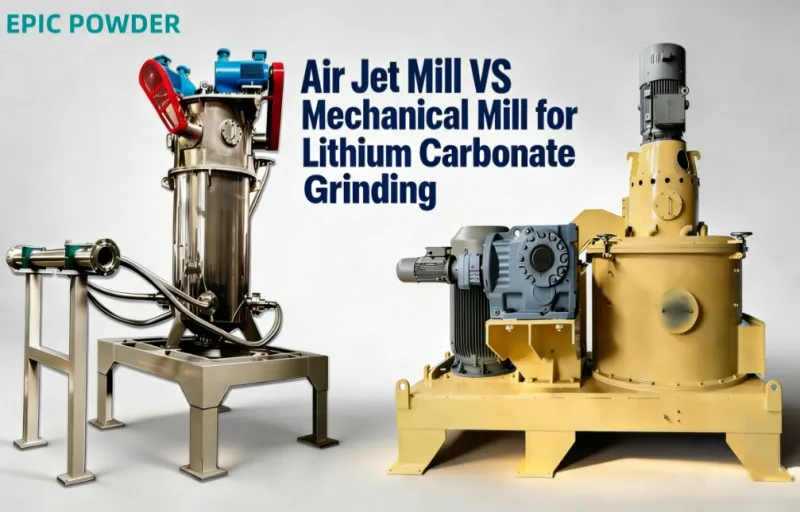
Jet mills and mechanical mills each have unique strengths. However, considering lithium carbonate’s characteristics—such as hygroscopicity, moderate hardness, and high purity requirements—their suitability differs significantly.
Working Principle and Advantages of Jet Mills
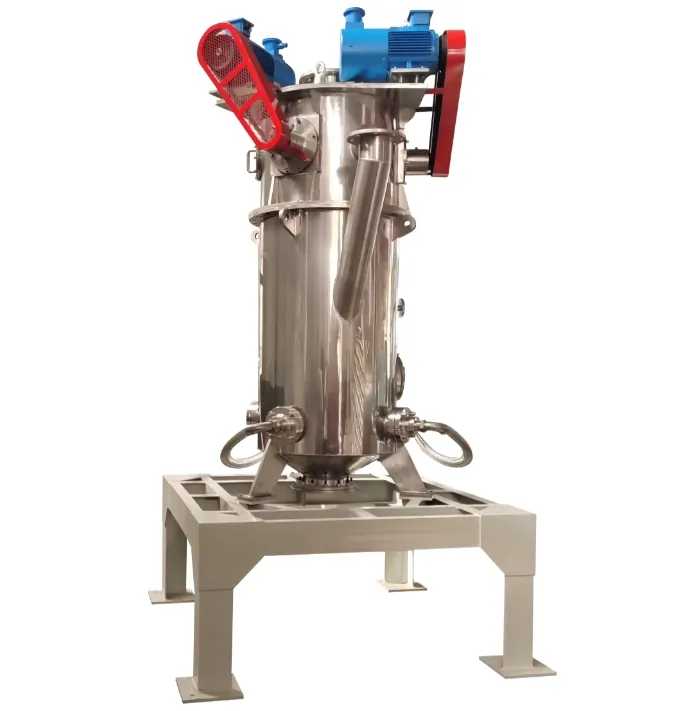
A jet mill, also known as a fluidized bed opposed jet mill, uses high-speed airflow to achieve particle collision and size reduction.
Its core principle involves compressed air or inert gas (such as nitrogen) accelerated through Laval nozzles to supersonic speeds, reaching several hundred meters per second. This creates a turbulent flow field inside the grinding chamber.
Material particles collide, rub, and shear against each other in the airflow. This enables self-grinding without mechanical contact.
An integrated classifier wheel, such as a turbine classifier, separates fine particles from coarse ones. Fine particles exit with the airflow, while coarse particles return for further grinding.
This non-contact grinding method is particularly suitable for materials requiring high purity.
Advantages in Lithium Carbonate Ultrafine Grinding
High fineness and narrow particle size distribution
Jet mills can easily reduce lithium carbonate to D50 < 5 μm, even reaching submicron levels. The particle size distribution is steep, with a Span value < 1.5.
High-speed interparticle collision effectively breaks hard agglomerates without over-grinding softer particles. Mechanical mills often struggle to achieve such fine and uniform distribution.
Low contamination and high purity
Since no grinding media such as hammers or liners directly contact the material, jet mills minimize metal contamination.
This is critical for battery-grade lithium carbonate. Even trace amounts of iron or chromium can cause short circuits or capacity decay. Studies show that jet-milled lithium carbonate can reach purity levels above 99.99%.
Low-temperature operation
The expansion of compressed gas absorbs heat. This keeps material temperature below 50°C. It is suitable for heat-sensitive lithium carbonate and prevents decomposition or crystal phase transformation.
Continuous production and automation
Jet mills often operate in closed-loop systems. They support large-scale continuous production, with capacities reaching tons per hour. This makes them suitable for industrial applications.
Limitations of Jet Mills
Jet mills are not without drawbacks. Their main disadvantage is relatively high energy consumption. Each ton of product may require several hundred kilowatt-hours due to high-pressure gas supply requirements.
Initial investment costs are also higher. Additionally, they are sensitive to material moisture and usually require pre-drying to below 1%.
Working Principle and Advantages of Mechanical Mills
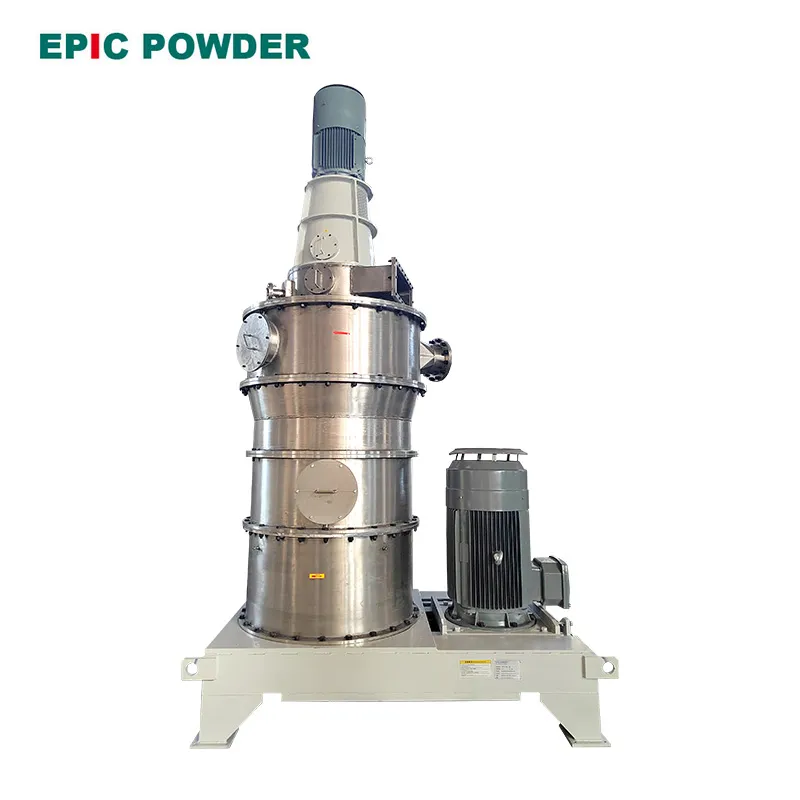
Mechanical mills rely on mechanical forces such as impact, shear, and grinding to reduce particle size. They include hammer mills, ball mills, vibration mills, and stirred mills.
Taking a high-speed mechanical impact mill as an example, the rotor rotates at several thousand revolutions per minute. Hammers or pins strike and rub the material to achieve size reduction. The ground material exits through screens or classifiers.
Advantages in Lithium Carbonate Applications
High efficiency and lower energy consumption
Mechanical mills have relatively high energy utilization efficiency. Lithium carbonate has a Mohs hardness of 3–4, making it suitable for mechanical grinding.
Compared with jet mills, mechanical mills may reduce energy consumption by 30%–50% because energy directly acts on particles rather than airflow. This offers significant cost savings for large-scale production.
Strong processing capacity
Mechanical mills can handle materials with higher moisture content, typically below 5%, without strict pre-drying.
Their structure is relatively simple, and maintenance costs are low. Single-machine capacity can reach several tons per hour. They are suitable for combined coarse and fine grinding processes.
High flexibility
Grinding performance can be optimized by adjusting rotor speed, grinding media (such as ceramic balls), or liner materials. Some mechanical mills also support wet grinding, which reduces dust emissions.
Limitations of Mechanical Mills
Potential contamination
Direct contact between grinding components and materials may introduce metal or non-metal impurities. Even ceramic liners cannot completely eliminate wear, especially when breaking hard agglomerates.
Limited particle size control
Mechanical mills typically achieve D50 values of 10–20 μm. Distribution is wider, with Span values > 2.
Over-grinding may generate excessive fine powder, increasing separation difficulty.
Heat accumulation
High-speed mechanical friction generates heat. Material temperatures may exceed 100°C. This can cause localized decomposition, moisture absorption, or agglomeration of lithium carbonate.
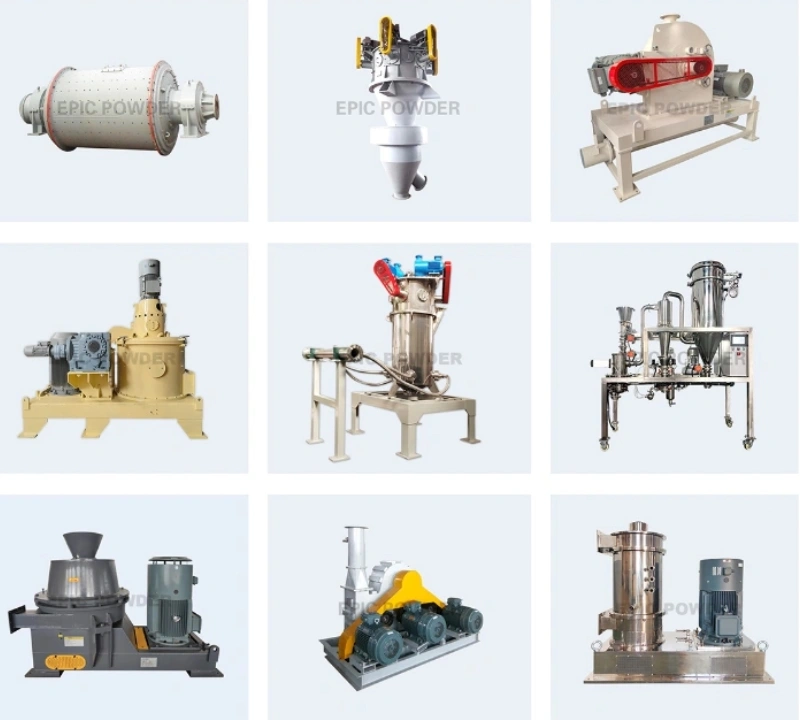
Direct Comparison: Jet Mill vs. Mechanical Mill
In lithium carbonate ultrafine grinding, the comparison can be summarized as follows:
Fineness
Jet mills perform better. They can consistently achieve <5 μm levels. Mechanical mills are more suitable for above 10 μm. High-end lithium batteries such as NCM811 require ultrafine lithium carbonate.
Energy consumption and cost
Mechanical mills are more economical in terms of energy and equipment price. However, jet mills can offset higher operating costs through the added value of high-purity products.
Purity and safety
Jet mills ensure contamination-free processing. They are ideal for battery-grade applications. Mechanical mills may require additional purification steps.
Material characteristics
Lithium carbonate often forms hard agglomerates. Jet mills provide stronger multidirectional collision forces for deagglomeration. Mechanical mills are more suitable for softer polycrystalline agglomerates.
Environmental impact
Jet mills generate less dust and noise but require exhaust gas handling. Mechanical mills may generate more vibration and dust but can be equipped with dust collectors.
In practice, many lithium salt producers, such as Ganfeng Lithium and Tianqi Lithium, have shifted toward jet-mill-based production lines to meet strict downstream battery manufacturer requirements.
Question 1: How Can Impurity Contamination Be Avoided in Lithium Carbonate Ultrafine Grinding?
Impurity contamination is a common pain point, especially iron and silicon elements that degrade battery performance.
Answer: Jet mills should be prioritized. Grinding relies on interparticle collision without mechanical wear sources. Using inert gas such as nitrogen further isolates oxygen and moisture, preventing oxidation or moisture absorption.
Mechanical mills require high-wear-resistant ceramic liners and regular impurity monitoring. However, contamination risks cannot be completely eliminated. In practice, jet mills can control impurity introduction to ppm levels.
Question 2: Why Is Mechanical Milling Less Effective Than Jet Milling for Lithium Carbonate Ultrafine Grinding?
Although mechanical mills are efficient, their impact force may be insufficient to fully break hard lithium carbonate agglomerates. This can prolong grinding time and waste energy.
Lithium carbonate particles exhibit strong van der Waals forces. Mechanical impact distributes energy linearly and unevenly. In contrast, jet mills create multidirectional turbulent collisions, which are more effective.
Additionally, heat generated by mechanical friction may cause material adhesion to chamber walls or secondary agglomeration, reducing output.
Studies indicate that, for the same fineness target, jet mills demonstrate 20%–30% higher overall efficiency when purity and distribution are considered.
Which Equipment Is More Suitable for Lithium Carbonate Ultrafine Grinding?
Based on the above analysis, jet mills are more suitable for lithium carbonate ultrafine grinding.
Especially for battery-grade applications, their high purity, ultrafine control capability, and low-temperature operation are difficult for mechanical mills to match.
Although energy consumption is higher, the return on investment is shortening as the lithium battery industry scales up.
For cost-sensitive industrial-grade lithium carbonate, mechanical mills can serve as auxiliary equipment for preliminary coarse grinding. A combined process of “mechanical coarse grinding + jet fine grinding” can optimize overall efficiency.
In the future, technological advancements such as intelligent classification systems and energy recovery designs will further enhance jet mill advantages.
In conclusion, in the pursuit of high-quality lithium materials, jet mills are not only tools but also engines driving industrial upgrading.

“Thanks for reading. I hope my article helps. Please leave a comment down below. You may also contact Zelda online customer representative for any further inquiries.”
— Posted by Emily Chen