
Project Overview & Challenges:
Client / Market: A major marine biotechnology company in Thailand.
Product Application: High-quality ultrafine seaweed powder used for health foods, dietary supplements, and natural cosmetic ingredients. The powder requires extremely fine particle size and excellent uniformity to ensure high bioavailability and a smooth mouthfeel.
Key Challenges
Fibrous material difficulty:
Seaweed contains large amounts of gel-like substances and plant fibers. Traditional mechanical milling tends to cause fibrous pulling and screen clogging, making it difficult to achieve ultrafine fineness.
Heat sensitivity:
Active nutrients in seaweed (such as polysaccharides and vitamins) are heat-sensitive. The grinding process must strictly control temperature rise to prevent nutrient degradation.
High fineness with high capacity:
The system must achieve ultrafine seaweed powder with D50 = 20 μm while maintaining a stable throughput of 100 kg/h.
Core Performance Requirements
- Final powder median size D50 ≤ 20 μm
(equivalent to over 700 mesh; cell walls are nearly invisible under a microscope) - Throughput ≥ 100 kg/h (dry basis)
- Microbial, heavy metal, and pesticide residue compliance
with EU EC 1881/2006 and Japan’s Positive List System - Low temperature, no metal contamination, maximum retention of color and nutrients
Equipment Selection
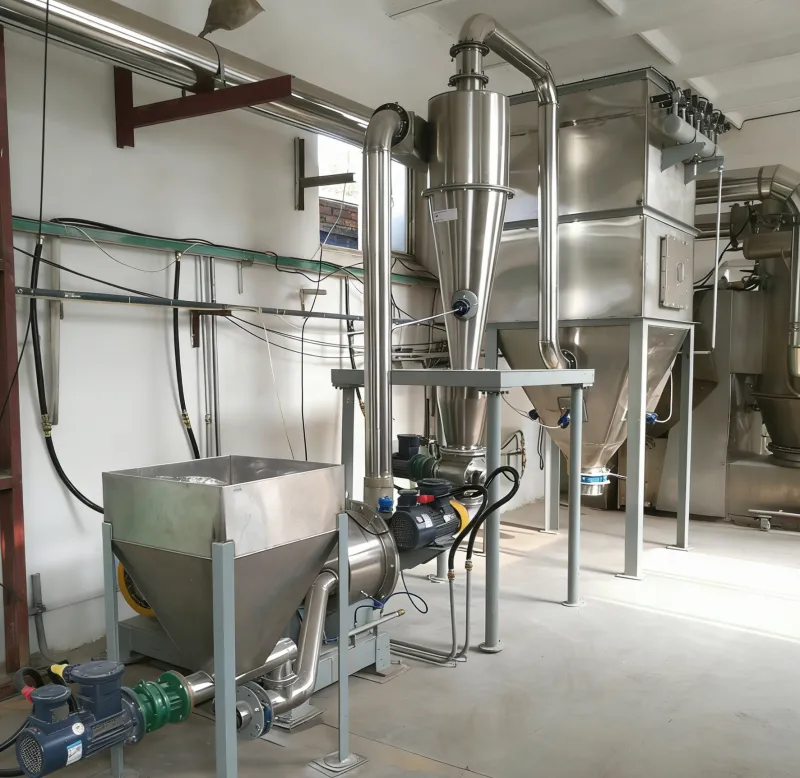
The production line uses the Epic Powder Horizontal Classifier Mill, specifically designed for ultrafine grinding of fibrous and heat-sensitive materials.
Grinding Equipment: Epic Powder Horizontal Classifier Mill
Working Principle:
The horizontal classifier mill integrates impact milling with dynamic classification. The material undergoes repeated impact, shear, and friction between high-speed rotating components and liners to achieve ultrafine grinding.
Advantages of the Horizontal Design
Excellent for fibrous materials:
Optimized internal structure and impact blades efficiently cut seaweed fibers and gels, avoiding entanglement and clogging—problems common in traditional vertical mills.
Superior temperature control:
Horizontal mills typically feature more effective airflow cooling systems. The chamber design also facilitates rapid heat dissipation, ensuring maximum preservation of heat-sensitive nutrients.
Integrated classification:
A dynamic classifier wheel is built inside the mill or at the outlet. Coarse particles are automatically returned for re-grinding, ensuring stable D50 = 20 μm fineness and a narrow particle size distribution.
Acceptance Test Results
| Parameter | Result |
|---|---|
| Final Powder Size | D50 = 18.3–19.6 μm; D97 ≤ 45 μm |
| Particle Size Distribution (Span) | 0.95–1.05 (very narrow) |
| Measured Throughput | 105–118 kg/h (varies by seaweed species) |
| Grinding Temperature | Max 34.8°C |
| Cell Wall Disruption Rate | ≥ 98% (cell wall fragments nearly invisible) |
| Color Difference (ΔE) | < 1.2 (almost identical to raw material) |
| Microbial Count | < 500 CFU/g; E. coli not detected |