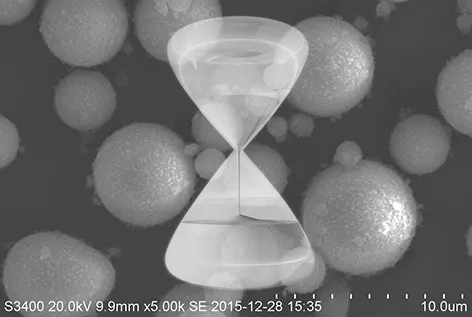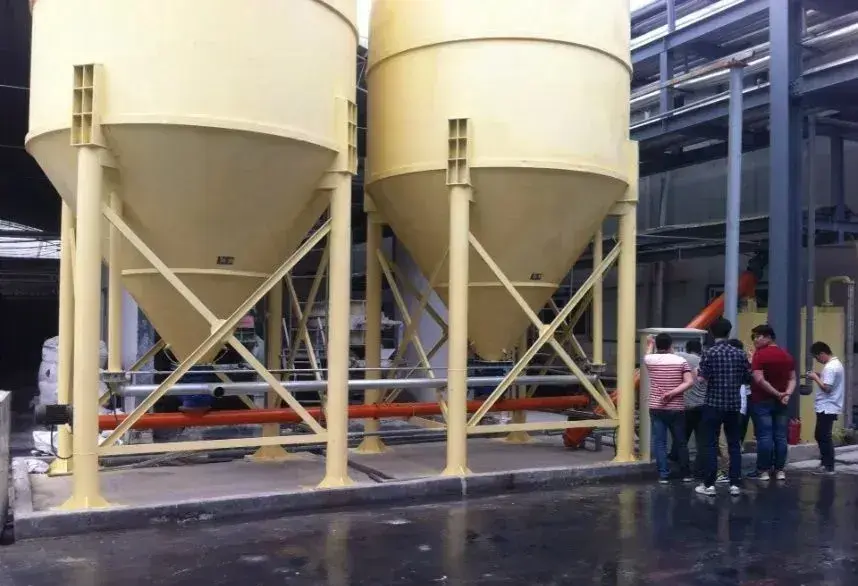
In the world of chemical and materials industries, there is a seemingly ordinary yet highly functional material – talc powder. You may have heard of it, but do you know that after “activation,” talc powder can play a role similar to a “reinforcing skeleton” in plastics, rubber, and other products? Today, let’s take a closer look at this quietly powerful “functional powder” in industry – active talc powder.
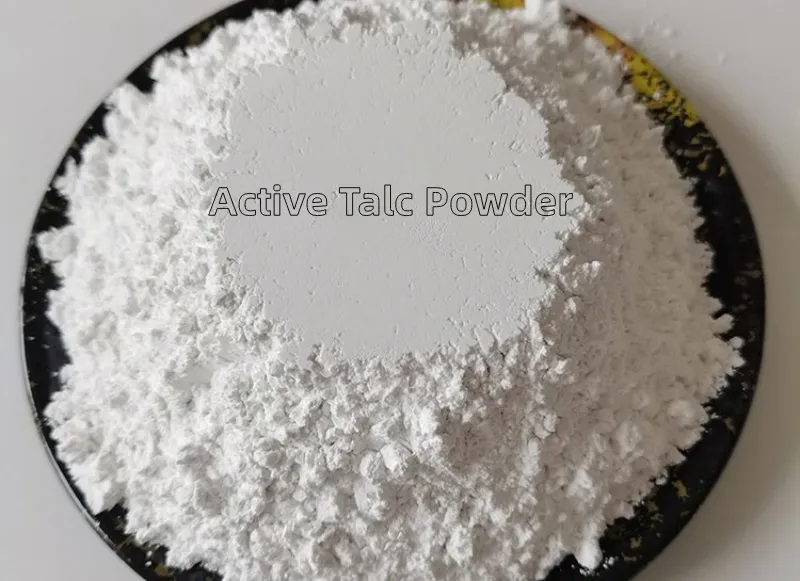
What is Active Talc Powder?
Active talc powder, as the name suggests, is talc powder that has undergone special surface activation treatment. Talc itself is a natural mineral, mainly composed of magnesium silicate, with a soft and fine texture.
However, ordinary talc powder does not interact well with polymers such as plastics and rubber. It is hydrophilic and not oleophilic, disperses unevenly in polymers, and tends to agglomerate, which negatively affects material performance.
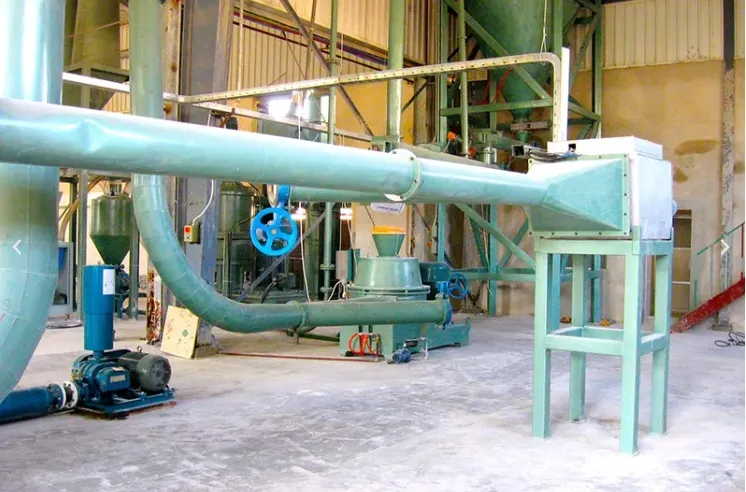
Activation treatment is like putting an “organic coat” on the talc powder. Using advanced equipment with heating and high-speed mixing, surfactants are evenly coated on the surface of each talc particle. This process transforms the powder from hydrophilic and oleophobic to oleophilic and hydrophobic, enabling better compatibility with plastics, rubber, and other polymer materials.
Talc Powder Modification Technologies
To enhance dispersion, interfacial bonding, and overall performance in polymers, the industry commonly uses multiple modification methods. These are mainly divided into physical modification and chemical modification.
1. Physical Modification
Physical modification primarily improves dispersion by changing particle morphology and surface energy.
- Ball milling or vibration milling: Reduces average particle size and increases specific surface area, making the powder easier to disperse in the polymer matrix.
- Heat treatment/drying: Removes surface moisture, reduces hygroscopicity, and improves compatibility with hydrophobic polymers.
- Surface coating or spraying: Forms a physical coating layer on the powder using polymeric surfactants or fatty acids, enhancing oleophilicity and flowability.
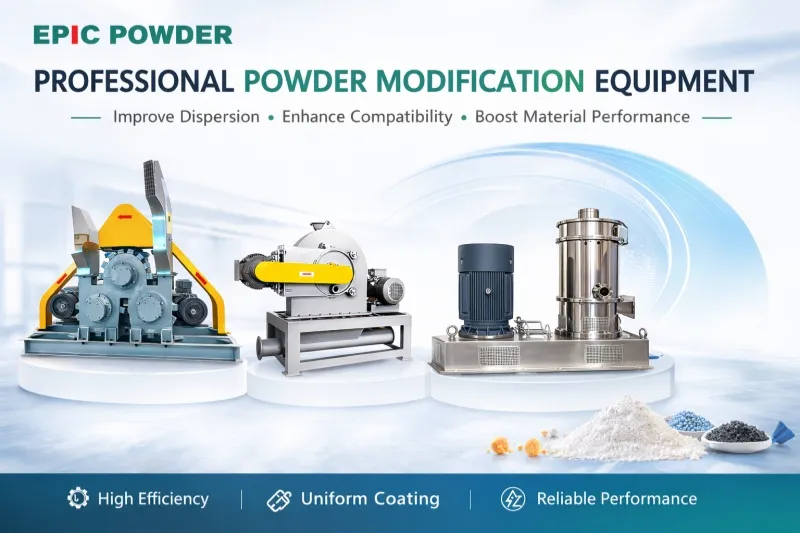
Common equipment for coating modification includes: three-roller coating machine, pin mill coating machine, এবং turbo mill coating machine.
2. Chemical Modification
Chemical modification changes the surface chemical structure of talc powder, enhancing compatibility with polymers at the atomic or molecular level.
- Organosilane coupling agent modification: Reacts with hydroxyl groups on the talc surface to form stable chemical bonds. The organic ends of the coupling agents can interact with polymer chains, increasing interfacial adhesion.
- Fatty acid or amide treatment: Adsorbs a layer of long-chain organic molecules onto the talc surface, making particles hydrophobic, which improves dispersion in polyolefins or rubber.
- Surface polymerization or polymer coating: Conducts in-situ polymerization on the powder surface to form a polymer film, strengthening the interface and significantly enhancing mechanical properties and thermal stability.
These modification methods can be used individually or in combination. For example, talc powder that has been micronized by ball milling can be further treated with silane coupling agents, achieving both good dispersion and enhanced interfacial adhesion.
How Active Talc Powder Works
You can imagine polymer materials (such as plastics or rubber) as a tangled fishing net, and talc powder as the small stones filling the net.
If the stones have smooth surfaces and do not adhere well to the net, the net will easily tear under stress. However, if each stone is coated with a “sticky outer layer,” it can bond closely with the net, making the entire structure more robust.
Active talc powder functions through this “coating–bonding” mechanism:
- Improved dispersion: Activated talc powder disperses uniformly in the polymer matrix without agglomeration or sedimentation.
- Enhanced interfacial bonding: The organic coating interacts chemically or physically with the polymer, forming a strong “handshake.”
- Final effect: Significantly improves impact resistance, strength, and dimensional stability of the final product while reducing raw material costs, making it an excellent incremental filler additive.
Key Technical Indicators
From a product parameter perspective, this active talc powder has several highlights:
- Whiteness 92%: Clean appearance, suitable for light-colored or white products.
- Silicon content 45%: Good stability, helps improve heat resistance and rigidity.
- D50 of 7.5 μm: Fine particle size, easy to disperse, does not affect the surface smoothness of the product.
- Loss on ignition 18%: Indicates moderate organic coating content, enough for activation without affecting high-temperature processing.
Active Areas of Application
- Polyolefin Modified Granules
Commonly used to enhance toughness in PP, PE, and other plastics, such as automotive bumpers, appliance housings, and logistics pallets, making plastic products more durable and lighter. - Rubber Reinforcement Modification
Used in tires, seals, and conveyor belts to improve wear resistance and aging resistance. - Rubber Foamed Footwear Materials
Adding active talc powder to foamed midsoles and insoles of sneakers or casual shoes can improve elasticity, reduce weight, and enhance molding stability.
উপসংহার
Material science development often relies on these minor improvements. Active talc powder is just one of many fillers. However, it plays an irreplaceable role in modern manufacturing. It enhances polymer performance and reduces costs through excellent interfacial modification.
In the future, polymer materials will continue to evolve. They will become more high-performance, lightweight, and eco-friendly. Consequently, the use of these “smart fillers” will grow even more widespread. Your next pair of sneakers might contain active talc powder. Your next car may also rely on this quiet technical contribution.
"পড়ার জন্য ধন্যবাদ। আশা করি আমার লেখাটি আপনার কাজে লাগবে। অনুগ্রহ করে নিচে একটি মন্তব্য করুন। আরও যেকোনো প্রশ্নের জন্য আপনি Zelda অনলাইন গ্রাহক প্রতিনিধির সাথেও যোগাযোগ করতে পারেন।"
— পোস্ট করেছেন এমিলি চেন